Category Archives: Business/Economics

What Economic Recovery? Global demand & decreased U.S. production could result in sky high Diesel fuel prices!

“The government does not want to tell the truth in the Parliament. It wants to run away from the coalgate scam [a reference to a political scam involving coal allocations in India] and wants to evade the issue of corruption by raising the fuel price….Once the session is adjourned, government and the oil marketing companies will go for another hike in the price of diesel, petroleum, and other petroleum products and it has become a routine for the Congress….”-Prakash Javadekar, Bharatiya Janata political party in India

In the United States, as of 05 September 2012, the contract price for New York Ultra Low Sulfur Diesel (ULSD) was at $3.15 USD per gallon for delivery on 12 October 2012.  That can be considered the wholesale price before it gets to the gas station.  You can add another one or two dollars, plus taxes, retail at the pump in October.

The 05 September contract is not as high as the peak in March 2012, that hit $3.30, wholesale.  The 2012 low contract price for ULSD was in June, at $2.70 per gallon, but it’s been rolling back uphill ever since.
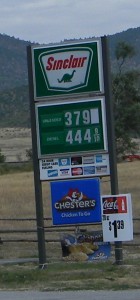
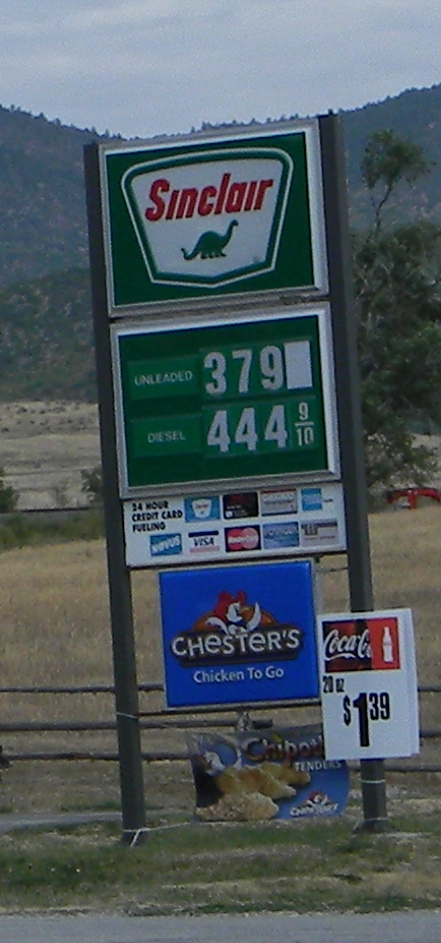
Near Lava Hot Springs, Idaho, 07 September 2012.

In India, rising costs of Diesel and Kerosene are being blamed on inflation (usually caused by increased demand) and the increased costs of fuel production.  Most refiners in India are government owned, and they claim production costs have gone up 28%, and they want to pass it on to consumers.  There’s no detailed explanation as to why production costs are up, the most obvious reason is that crude oil prices have gone up (it accounts for 60% of refining costs in the United States).

New Zealanders are complaining, even though their fuel prices have come down since they hit record levels in May (for gasoline) and July (for Diesel).  The problem is New Zealand imports its fuel.

More people, outside the U.S., use Diesel because it is more efficient than gasoline (petrol), thus part of the reason for the increased demand globally.  But in the United States, emission laws, and a bad stigma, has Diesel relegated mainly to the transportation industry, with relatively few personal vehicles running on Diesel.  Just think what would happen if tens of thousands more people in the U.S. started driving clean burning Diesel powered cars that get 50 miles per gallon?

But what about supply and demand here in the United States?

According to a report by Institute for Supply Management Non-Manufacturing Business Survey Committee, August commodity prices, and supply levels, are not consistent with supply and demand.

The report says fuel prices are up, but supply is not down!  It stated that Diesel 1 & 2, and gasoline up in price, yet “….no commodities reported in short supply.”

However, at the end of August 2012, California reported a 15% drop in CARB (California blend) Diesel inventories.  The result was that prices for CARB Diesel commodities traded in San Francisco hit highs not seen since 2007!  But that should affect only California, with their narcissistic environmental policies.

The main reason for the drop in California fuel supplies is blamed on refineries shutting down for maintenance.  However, the Golden Eagle refinery was shut down due to a failed compressor on a hydrodesulfurization unit.  Then there’s the Richmond refinery which has been closed for a month due to a fire.

The U.S. Energy Information Agency (USEIA) is reporting some interesting, and at first glance, conflicting data for the whole country, such as bio-Diesel production is way up.

From January to June 2012, 523 million gallons of bio-Diesel (From vegetation, by the way that’s what Rudolf Christian Karl Diesel intended his original Diesel engine to run on.) were produced.  That’s 158 million more than the same time in 2011.

However, the USEIA shows a drop in petroleum based Diesel fuel (No thanks to Rockefeller and Standard Oil, Rudolph Diesel was sued and lost the right of the use of his name for the peanut oil based fuel for his engine. Rockefeller & Standard Oil created a petroleum based fuel they called Diesel.) for the month of August.  Petroleum based Diesel fuel is now officially called Distillate Fuel Oil.

According to USEIA data released on 06 September 2012, for the week ending 31 August distillate fuel oil (DSO) production was at 4,341,000 bpd (barrels per day).  That’s down 326,000 bpd from the week prior, and down 287,000 bpd from the last week of July.

Also, in the “Product Supplied” category, DSO actually supplied at the end of August was down from the week prior, by 342,000 bpd.  It was down by 525,000 bpd compared to the last week of July.

So production, and product supplied, dropped at the end of August.  So at first we could say prices are up because supply is down.  But wait, there’s more!

While production is down, stock piles are up!  Stocks of DSO jumped from 124,265,000 barrels at the end of July to 127,076,000 barrels at the end of August, an increase of 2,811,000 barrels!

How can stocks go up if production went down?  Imports!

Imported DSO has been going up.  At the end of July imported DSO was at 62,000 bpd.  By the end of August it jumped to 135,000 bpd!

What this means is that despite a glut of oil available for refining into fuels, petroleum Diesel production within the United States is going down (for various reasons, most known only to the oil/refining companies), resulting in an increase reliance on more imported Diesel, and driving fuel speculators to bid higher on future deliveries of domestic Diesel fuels.

Keep your fingers crossed for the new Diesel refinery to be built near Williston, North Dakota!
World War 3: U.S. occupation of Afghanistan; 30 Aug – 02 Sep. U.S. ends training of Afghan troops! U.S. bullying Afghanistan to end trade deals with Iran. Cops kill civilians! Australia will now stay in Afghanistan! Jihad called against Pakistan! Children beheaded!

02 September 2012

“The training of the ALP [Afghan Local Police] recruits has been paused while we go through this re-vetting process, to take a look at this process to see if there’s anything that we can improve. It may take a month, it may take two months, we don’t know.”-Lieutenant Colonel John Harrell

Reports that the United States has halted training of new Afghan soldiers, until every one can be investigated for ties to Mujahideen.  Of course this means that the United States can not meet its troop pullout goal, because that is based on Afghan government troops taking over most of the work, and if they are not going to be trained anymore, well then so much for the 2014 U.S. withdrawal date.

The Afghan Chamber of Commerce and Industry revealed that the United States has been bullying them to end all trade deals with Iran.  Iran is now the biggest supplier of fuel to Afghanistan, and Iran is now buying $1.3 billion USD worth of products from Afghanistan.  What has the United States done for Afghanistan’s economy?

ISAF said: “An International Security Assistance Force service member died as a result of a non-battle related injury in eastern Afghanistan today.”

Just four days after firing his intelligence chief, President Hamid Karzai now says the guy can stay until the end of his term in office.  Apparently it’s because the man intended to replace the current intelligence boss is being accused of running private prisons for torture!

In Kunduz Province, deputy provincial governor, Hamidullah Danishi, confirmed a report which said police massacred a village, killing at least 15 people. Some cops said they did it in retaliation for a policeman being killed by one of the villagers!  The result is an ongoing war between villagers and police, so far 10 cops have been killed in explosions and gun battles since the 15 civilians had been killed.

Australian Foreign Minister, Bob Carr, says Australia will not withdraw their Diggers early as planned.  A few months ago they said they would leave by early 2013, now they will stay until the end of 2014.

In Herat Province, a spokesman for the governor said a battle between local forces and Mujahideen left three Mujahideen dead.

01 September 2012

ISAF said: “Two U.S. Forces-Afghanistan service members died following an insurgent attack in Ghazni province, Afghanistan today.”

In Maidan Wardak Province, suicide bombers killed as many as 12 people. Local government officials say two cops and ten civilians were killed, but the Mujahideen say the ten were all U.S. led occupying forces.  “There were two heavy blasts which damaged some parts of the district chief’s office and the police headquarters, and ISAF forces are also there.”-Shahidullah Shahid, provincial government spokesman

The Hezbe-e-Wafaq Millie (National Unity Party) of Afghanistan has made the first national call to launch Jihad against Pakistan. The holy war was declared in Kabul.   The political party claims they have more than 1,000 signatures from Afghans wanting war with Pakistan: “Crossborder shelling from Pakistan is a clear invasion into Afghanistan and this cannot be ignored. We will go to eastern Kunar province with our volunteer brothers and will defend Afghanistan.”-Bismillah Sher, National Unity Party

President Hamid Karzai has condemned yet another night raid by U.S. troops. Government officials from Uruzgan Province said not only were people killed, but U.S. led forces kidnapped nine people!

31 August 2012

In Uruzgan Province, U.S. led occupying forces conducted an illegal night raid, which killed a 70 year old man and his son.

In Ghazni Province, local government officials claim Mujahideen assassinated five people for being anti-Mujahideen. The problem is that the so called ‘Mujahideen’ also burned Qurans, it sounds more like a U.S. led occupying force tactic.

Boys and girls are being found beheaded. In Kandahar Province, two boys, one 12 years old, and one 14 years old, were found beheaded in separate cases.   In Kapisa Province, a seven years old girl was found beheaded and her legs cut off.  Strangely no one has claimed they are missing a daughter!  Local government officials are blaming it on Mujahideen, of course.

30 August 2012

In Farah Province a fuel convoy headed for U.S. occupying NATO troops was ambushed. Four security guards were killed, two people wounded, two fuelers burned.

In Logar Province, five people were killed, 10 wounded, after a rocket hit the bus stop they were waiting at.  Local government officials speculate that Mujahideen were targeting a military base, and the rocket missed the intended target.

ISAF said: “Two International Security Assistance Force service members died following a helicopter crash in southern Afghanistan today.”

In Herat Province, Mujahideen attacked a security checkpoint, killing three Afghan government troops.

In Ghor Province, locals say a U.S. airstrike killed 12 civilians. U.S./ISAF/NATO claim the targets were Mujahideen.

In Helmand Province, Australian officials revealed that five of their Diggers were killed.  Three were killed by an Afghan government soldier, and two were killed when their helicopter went down.  “This is a very big toll… This is our single worst day in Afghanistan. Indeed this is the most lost in combat [for Australia] since the days of the Vietnam War.”-Julia Gillard, Prime Minister of Australia


What Economic Recovery? Central government cancels payments to local governments! Too Big to Fail bank panics!

04 September 2012, the central bank is injecting massive amounts of cash into the markets, trying to preemptively hold off a market crash!  This after the central government said it can no longer make tax grant payments to local governments!

The government of Japan announced early this morning that it can not make scheduled tax grant payments to local governments.  The payments amount to $52 billion USD.

The Bank of Japan responded by injecting $23 billion USD of cash into Japanese financial institutions.  This is to try and offset the loss of the central government’s tax grants.

Local governments normally transfer the tax grants into those financial institutions, but officials with the central government of Japan said that until a bill is passed to allow the issuing of more government bonds, they can not make the tax grant payments to local governments.

The bond bill is needed to raise at least 2/5-ths of the money required to run the central government for the next year.


What Economic Recovery? Romney’s Bain Capital at it again, this time it’s Alcoa vs Glencore!

Mitt Romney claims he’ll create “12 million” jobs as president of the United States, but his own creation, Bain Capital, is still hard at work destroying jobs.

This time it’s Alcoa (Aluminum Company of America) Incorporated, the number three aluminum producer in the world!

Today, 01 September 2012, Alcoa began shutting down its Italian operation on the island of Sardinia, despite weeks of protests by their employees, including on camera suicide attempts.

In the U.S. state of Texas, Alcoa sold land and assets from its Rockdale operation.  Smelting has been reduced, and two production lines closed.  Alcoa has reduced the number of Rockdale employees to about 70.

Why is Alcoa shutting down operations around the world, laying off thousands of employees, when back in July 2012 it claimed it’s sales were up more than expected due to increased demand for aluminum?

But that’ just it, demand is up, but prices are down, that’s right industrial metal prices are crashing!  So how does Alcoa deal with that? “I want to make one thing crystal clear here, the market is working…..people are moving forward with curtailing [production] and responding by slower build as we see in China and that’s clearly a function of the low LME [London Metal Exchange] pricing that we currently have in the market.”-Klaus Kleinfeld, CEO Alcoa

So the wise corporate leaders, in their greed, increased production so much that there is now too much metal on the market causing prices to crash, killing their hopes for high profits.  But who gets hurt? Why the lowly employees, of course.

(The number one aluminum company Rusal, and the number two, Rio Tinto, are also cutting back on production. Small companies are in trouble, credit wise, with the Too Big to Fail Banks, so expect hundreds of thousands of aluminum industry employees around the world to become unemployed!)

Reuters has just reported that Swiss investment giant (the biggest in the world), Glencore, wants to buy Alcoa’s Sardinia mining operation.  Here’s the Bain Capital connection.  Bain Capital is considered a ‘cornerstone investor’ in the world’s biggest investment company, Glencore!

The reason why the general public is only now hearing about the world’s largest investment company, Glencore, is that it finally went public with an IPO (Initial Public Offering) in May 2011.  Other investment companies bought into Glencore, such as Aabar, BlackRock Fund, Credit Suisse, Fidelity Investment Fund, UBS, Zijin Mining and others.  The IPO was handled by Too Big to Fail Citigroup, Morgan Stanley and Credit Suisse.

Here’s another trivial Romney connection to Alcoa; George Romney, Mitt’s father, worked for Alcoa as a lobbyist in the 1940s.

Alcoa is too big to be totally destroyed by vulture, I mean venture, capitalists (like Bain Capital), but it is being forced to sell off little bits of itself here and there.  And investors love it when people lose their jobs, stock prices for Alcoa Inc have been going up!  And Mitt Romney says he’ll do for America what he did with Bain Capital.


Uljin Reactor update: This is second Korean reactor to shut down in past week, inspections underway

24 August 2012, inspectors with the International Atomic Energy Agency (IAEA) and Korea Institute of Nuclear Safety, are trying to figure out why an Areva (Framatome) designed nuclear reactor shut itself down, after a warning alarm sounded.

But it turns out this isn’t the first time this has happened.  On 19 August 2012, a brand new reactor, the Sinwolseong-1 (aka Reactor 1 at Shin Wolsong) shut itself down as well.

Sinwolseong-1 began operation in January 2012. Officials ruled the shut down as being caused by a failure of the input controls.

According to the IAEA, Sinwolseong-1 and Uljin-1 (aka Reactor 1 at Ulchin) are both pressurized water reactors (PWR) operated by Korea Hydro & Nuclear Power Company.

Uljin-1 was designed by a French company called Framatome, now called Areva.

Doosan Heavy Industries claims Sinwolseong-1 is a reactor based on Korea’s first indigenous pressurized light water nuclear reactor design.  They have even sold the same type of reactors to China.

Korean Uljin Areva designed nuclear reactor shuts itself down, investigation as to why

On 23 August 2012, Reactor 1 of the Uljin (aka Ulchin) nuclear power plant in Korea, south, shut itself down.  Officials with the Korea Hydro & Nuclear Power Company do not know why.

A warning signal went off, but there is no radiation leak, according to officials.  Korean media says the International Atomic Energy Agency (IAEA) is not concerned.

Uljin-1 began operations in 1988 and is a French Framatome (company is now called Areva) type pressurized water reactor (PWR).  The Uljin nuclear plant is considered the 13th largest electricity generating facility in the world, producing nearly 5,900 megawatts.


Class Warfare: Quantitative Easing benefits top 5% of the rich, neutral or negative effect for everyone else! More proof it’s the fault of the Too Big to Fails!

23 August 2012, the Bank of England tried to make it look as though flooding the markets with cash is benefiting everyone. But their own words revealed the truth: “…asset purchases have boosted the value of households’ financial wealth held outside pension funds, although holdings are heavily skewed, with the top 5% of households holding 40% of these assets.”

Quantitative easing is a monetary policy that tries to stimulate the economy by buying up privately held financial assets.  But as the Bank of England (BoE) pointed out, 40% of those assets are owned by only 5% of the people in the United Kingdom!  You can be sure it’s a similar situation in the United States.

The BoE also admitted that traditional ‘savers’ are the ones who’re losing, as interest rates on traditional savings accounts are at record lows.  So much for trying to get people to put money away for a rainy day.

One British company, that offers financial services for people over 50 years of age, pointed out that retirees are the big losers in all this quantitative easing (QE): “…the 21 million over 50s…have been negatively impacted……It is asserted, but not proven, that pension savers are no worse off due to QE gilt buying [gilt is a British term for government bonds], because the value of their pension savings has gone up to offset the fall in the annuity income they will receive when converting their pension fund into a pension income. This assertion is simply not correct and the reality is very different for those recently or soon to be retired.”-Ros Altmann, Saga

The BoE tried to smooth things over by saying the worst that could happen to retirement funds is nothing: “….QE is estimated to have had a broadly neutral impact on the value of the annuity income that can be purchased from a typical personal pension pot invested in a mixture of bonds and equities.”

The British National Association of Pension Funds (NAPF) responded by pointing out that if pension funds were already in trouble before the QE started in 2009, and the QE has a neutral impact, then nothing has been improved (except for the rich).  The NAPF states that what has actually happened is that retirement funds are worse off as a result of QE: “…schemes that were already in substantial deficit before the financial crisis are likely to have seen those deficits increased.”

Essentially; quantitative easing only helps the 5% of the people (elites) holding financial assets (such as bonds), it is doing nothing, or actually making things worse, for 95% of the people!!!

What Economic Recovery? Australia’s Quantas reports first loss ever! Will hurt U.S. economy; no more Boeing orders!

23 August 2012, Australia’s Quantas Airways reported its first yearly loss since it was privatized 17 years ago.

Quantas lost $250 million USD from June 2011 to June 2012.  The airline blames the high cost of fuel, coupled with flight cancellations and employee strikes.

The loss means that Quantas will now put on hold a huge order (35 aircraft) for the latest 787 airliners made by U.S. company Boeing.


What Economic Recovery? Sony cuts 1,000 jobs in cell phone division!

23 August 2012, after buying back control of its Swedish cell phone operation, Sony announced it will lay off 15% of the employees.

Sony will also move most of the Mobile Communication division back to Japan.

Until Sony’s buyback, the Mobil Communication division was a joint venture with Sweden’s Ericsson.  The cuts are on top of planned lay offs in Sony’s television division.

Economic Recovery? No food crisis in Idaho, farmers see 15% increase in exports! Thank Canada and Mexico!

“With 96% of the world’s population and 80% of the world’s wealth being outside of the United States, the international market opportunities for agricultural products are great.”-Idaho Department of Agriculture

According to the Idaho Department of Agriculture, farm exports are up 15% compared to 2011, and 2011 was a record setting year!

“Canada and Mexico are Idaho’s largest agricultural export markets, with Japan and China following closely behind.”-Idaho Department of Agriculture

South Korea has also become a top importer of Idaho ag products, seeing a 98% increase since 2011!

Dairy has become Idaho’s number one ag product, making up 35% of Idaho’s exports! Compared to other U.S. states, Idaho’s exports rank 3rd for vegetables and 4th for dairy products (2011 stats).

For the first six months of 2012, total ag exports hit $2.7 billion USD for Idaho!  State officials thank currency exchange rates, strong commodity markets, trade agreements and growing international consumer demand.

It also doesn’t hurt that Idaho’s agricultural industry produces far more than what the state’s population of 1.5 million people can eat.

Unfortunately most of the employees of the Idaho ag industry are migrants.  Idaho employment laws allows farm workers to be paid less than minimum wage.