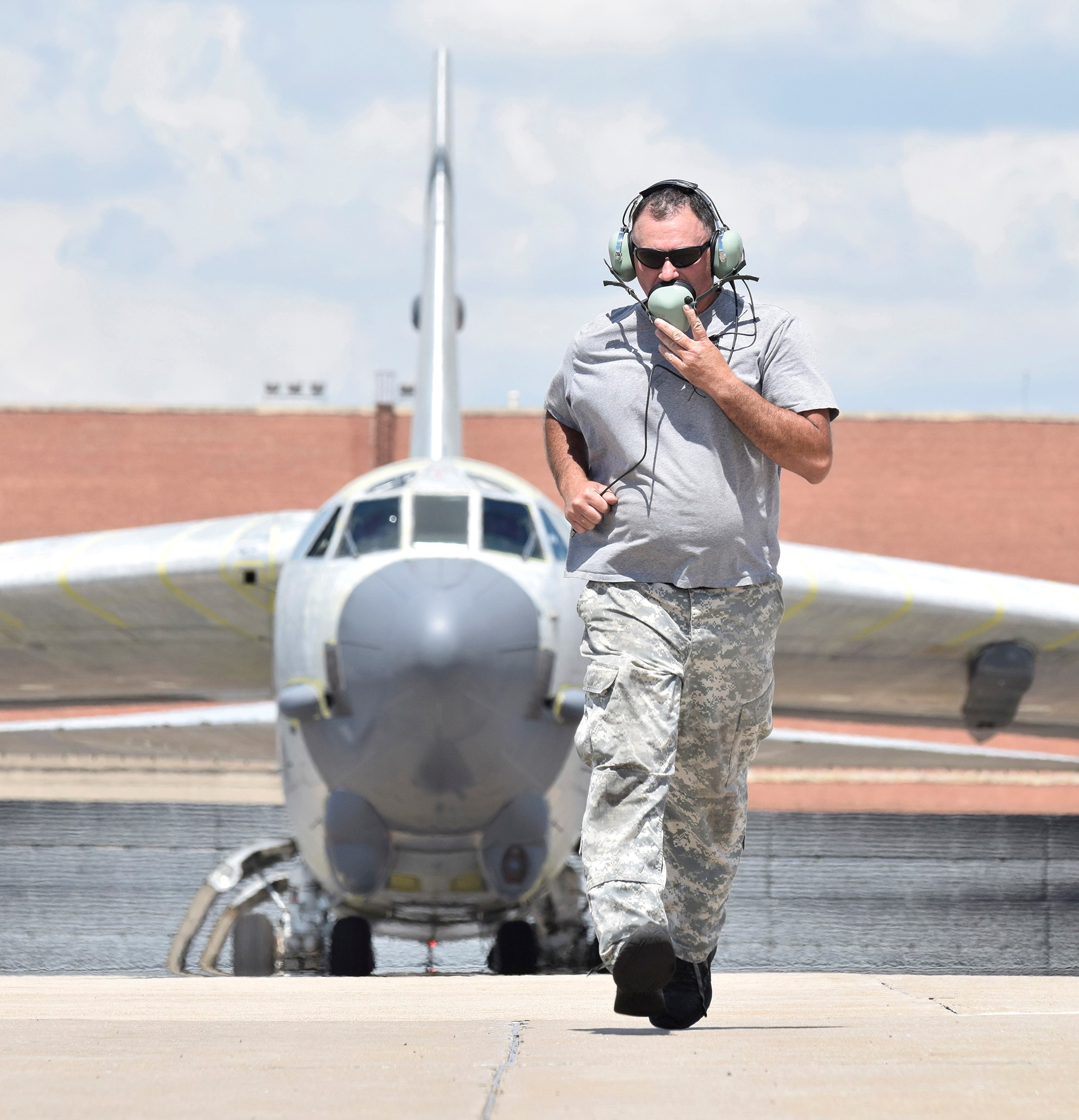
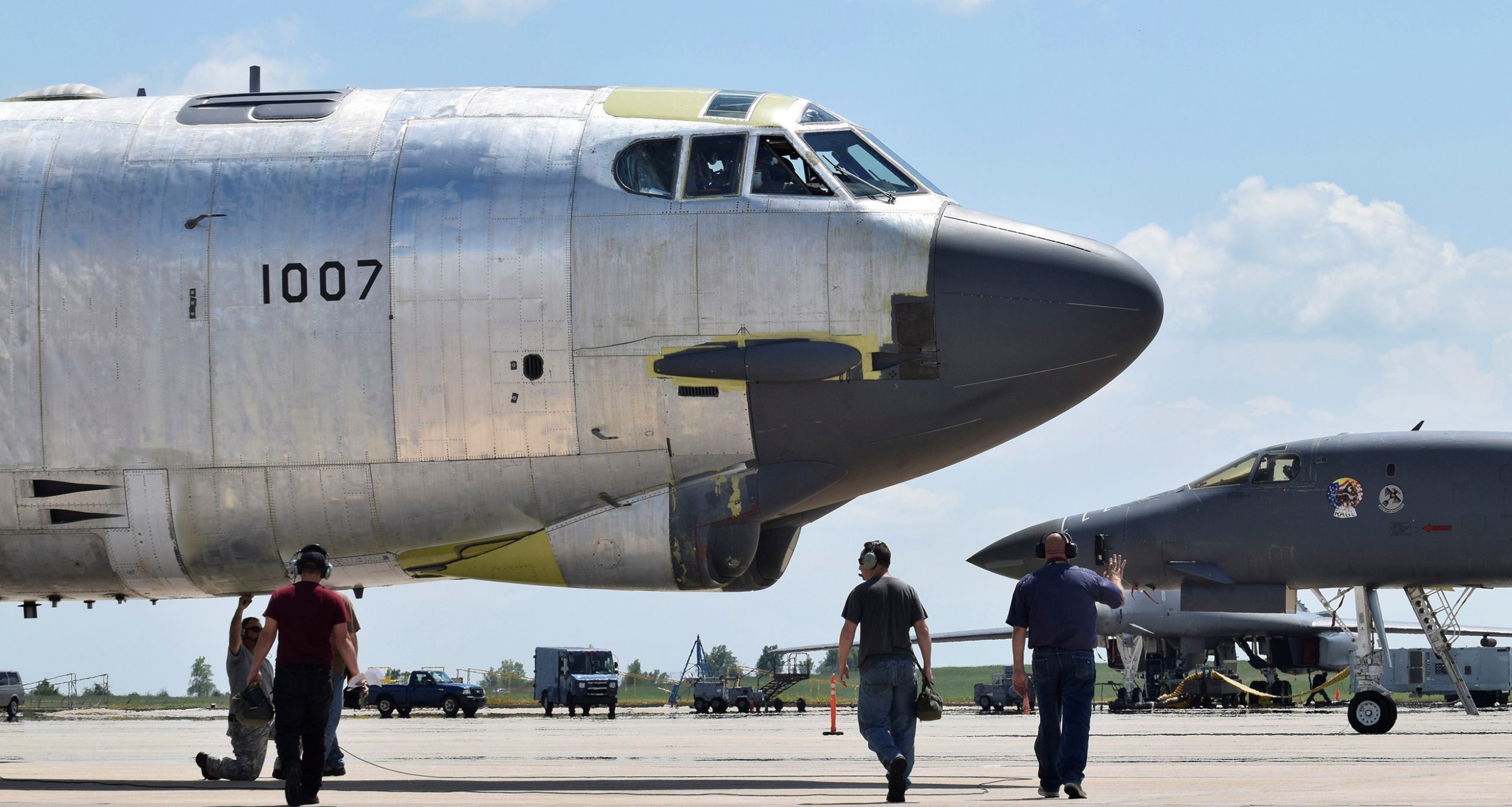
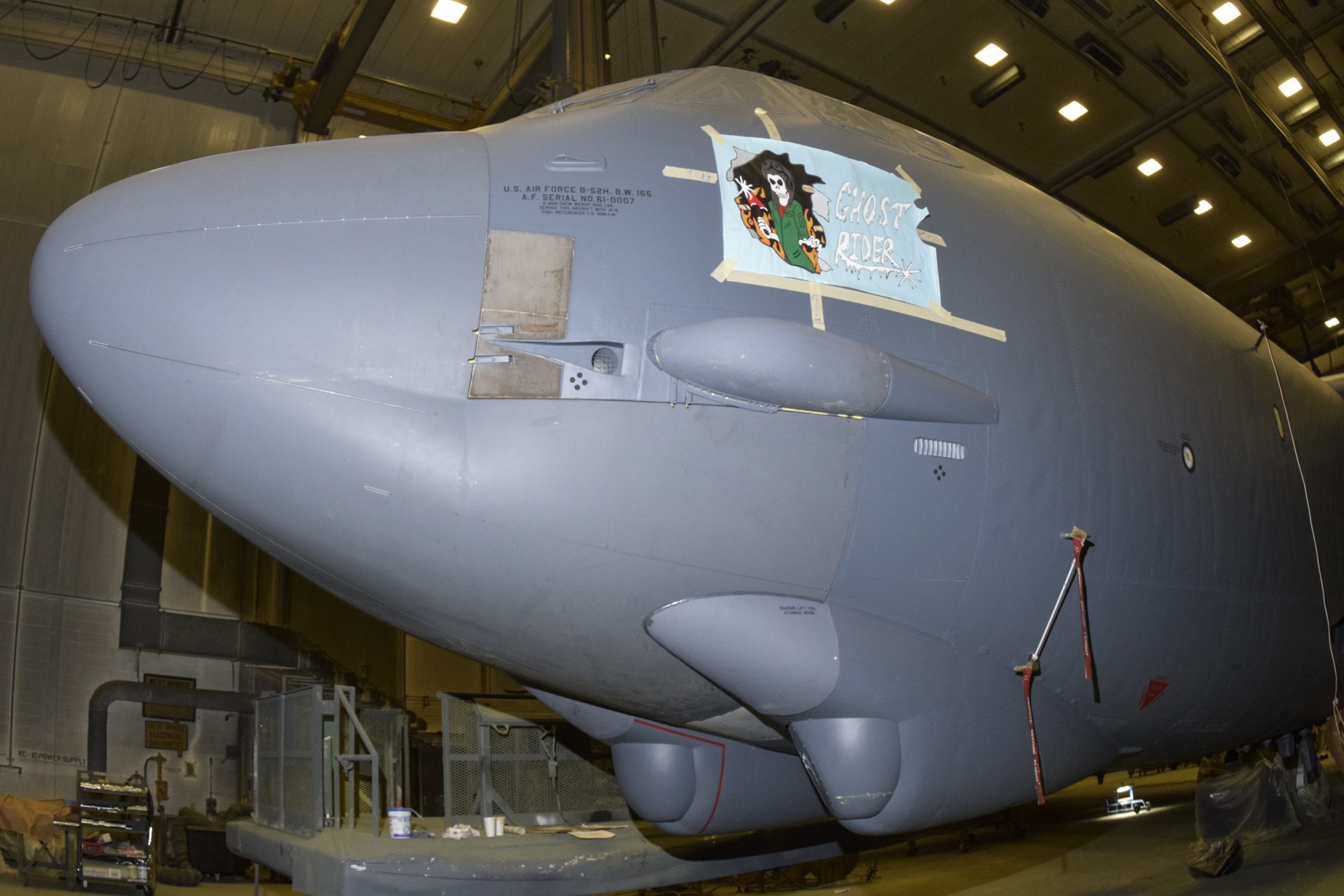
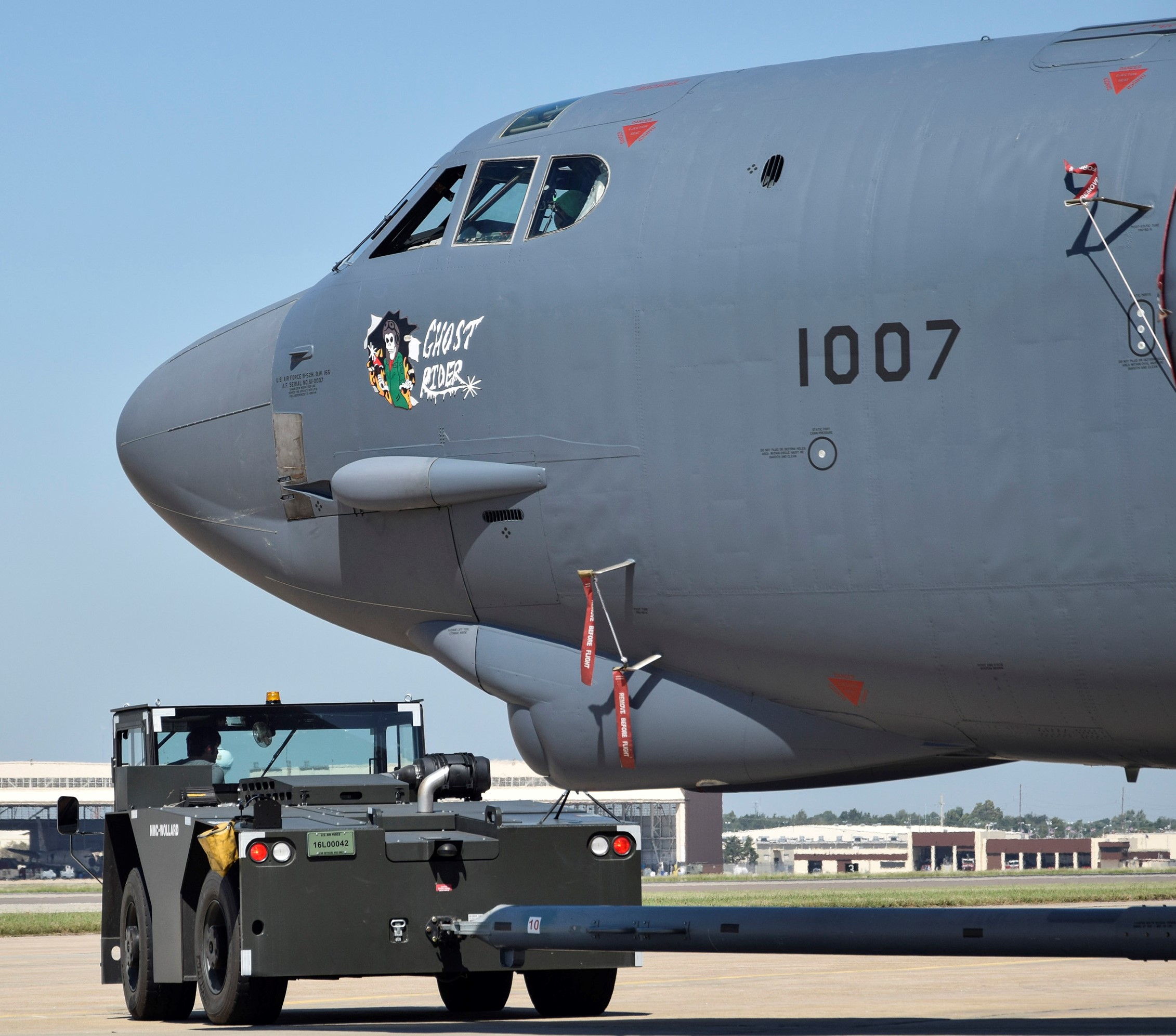
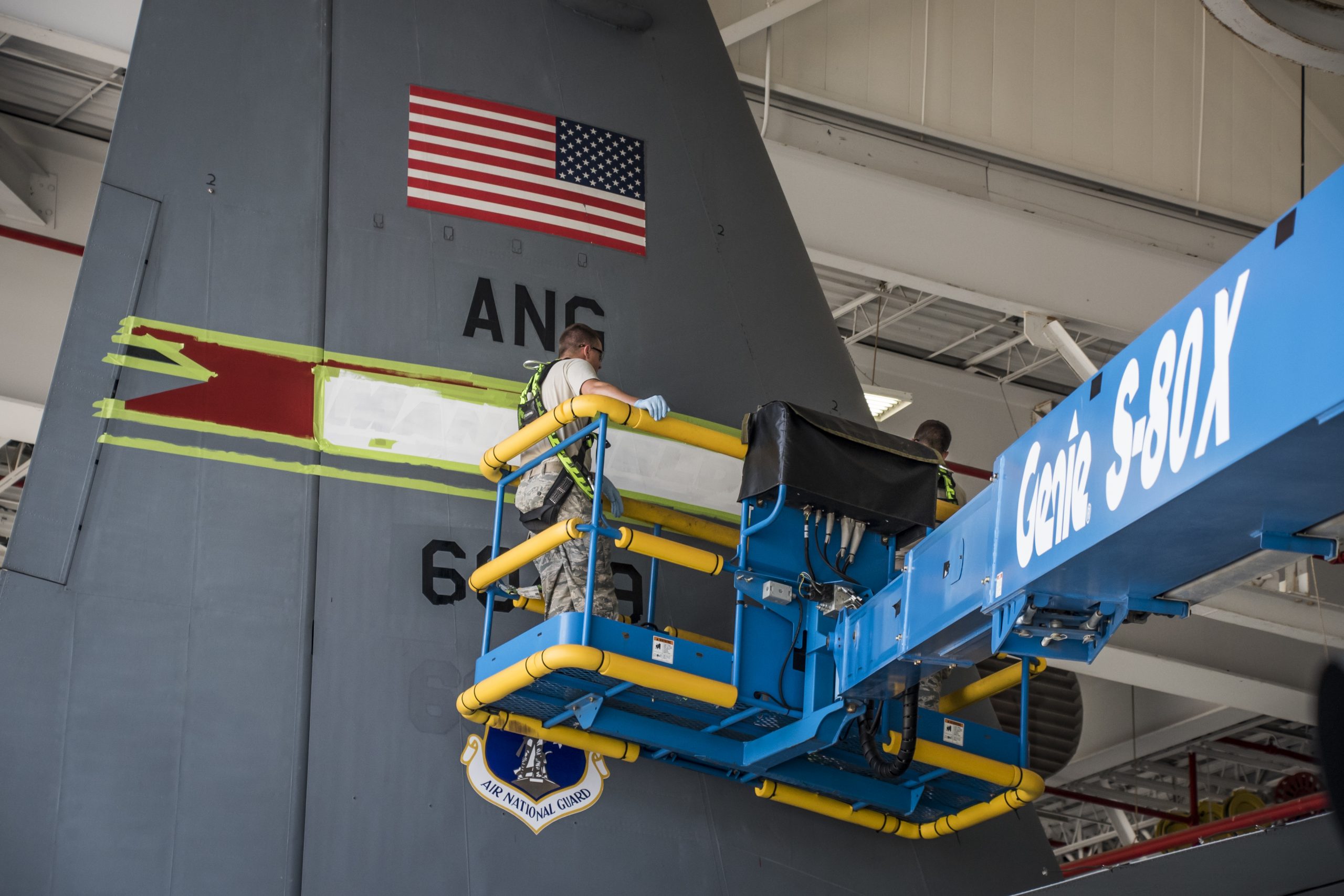
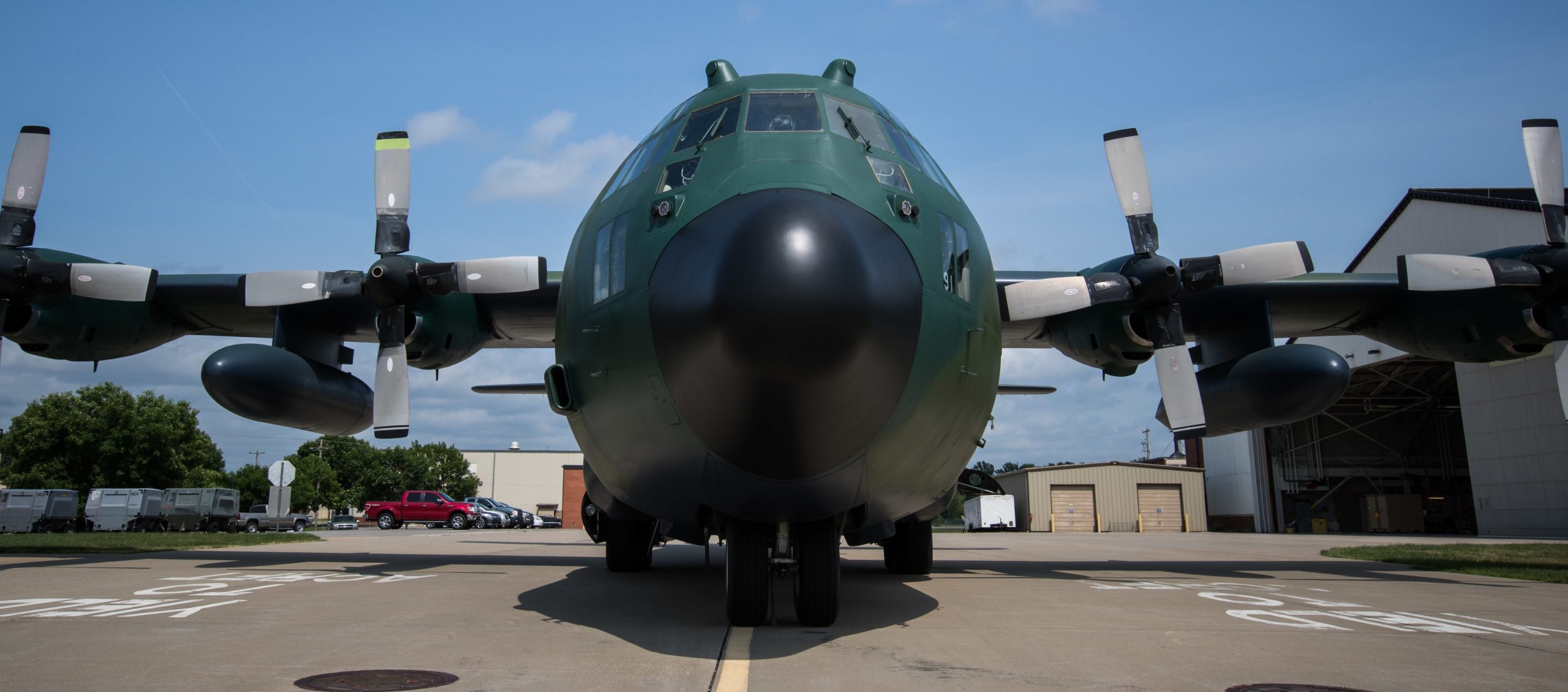
Ohio Air National Guard photo by Airman First Class Alexis Wade, 31JUL2019.
July 2019, Ohio National Guard C-130H2 gets new tail markings.
Video from 2018, Dobbins Air Reserve, Georgia, explains how they picked the nose art for their C-130s:
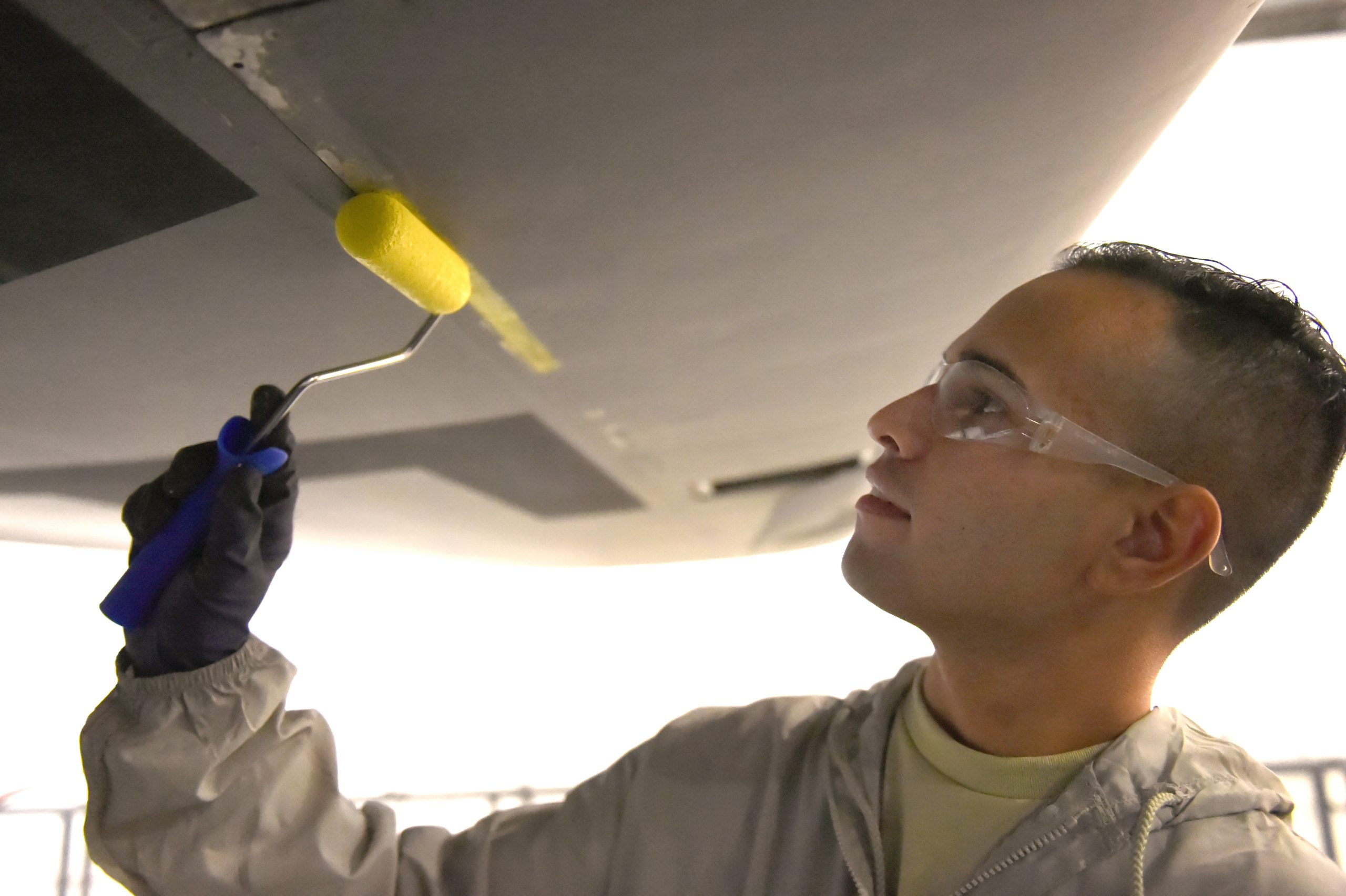
Wyoming National Guard photo by Sergeant First Class Jimmy McGuire, 16NOV2017.
In November 2017, after Hurricane Maria laid waste to Puerto Rico’s Air National Guard base their C-130Es were sent to Wyoming to get some depot maintenance. Yes, using a roller brush to apply primer paint.
Missouri Air National Guard photo by Airman First Class Audrey Chappell, 12JUN2018.
June 2018, this C-130H is fresh from the paint shop, with its Cold War era camo, heading to its new home as permanent ‘gate-guard’ for Rosecrans Air National Guard Base, Missouri.
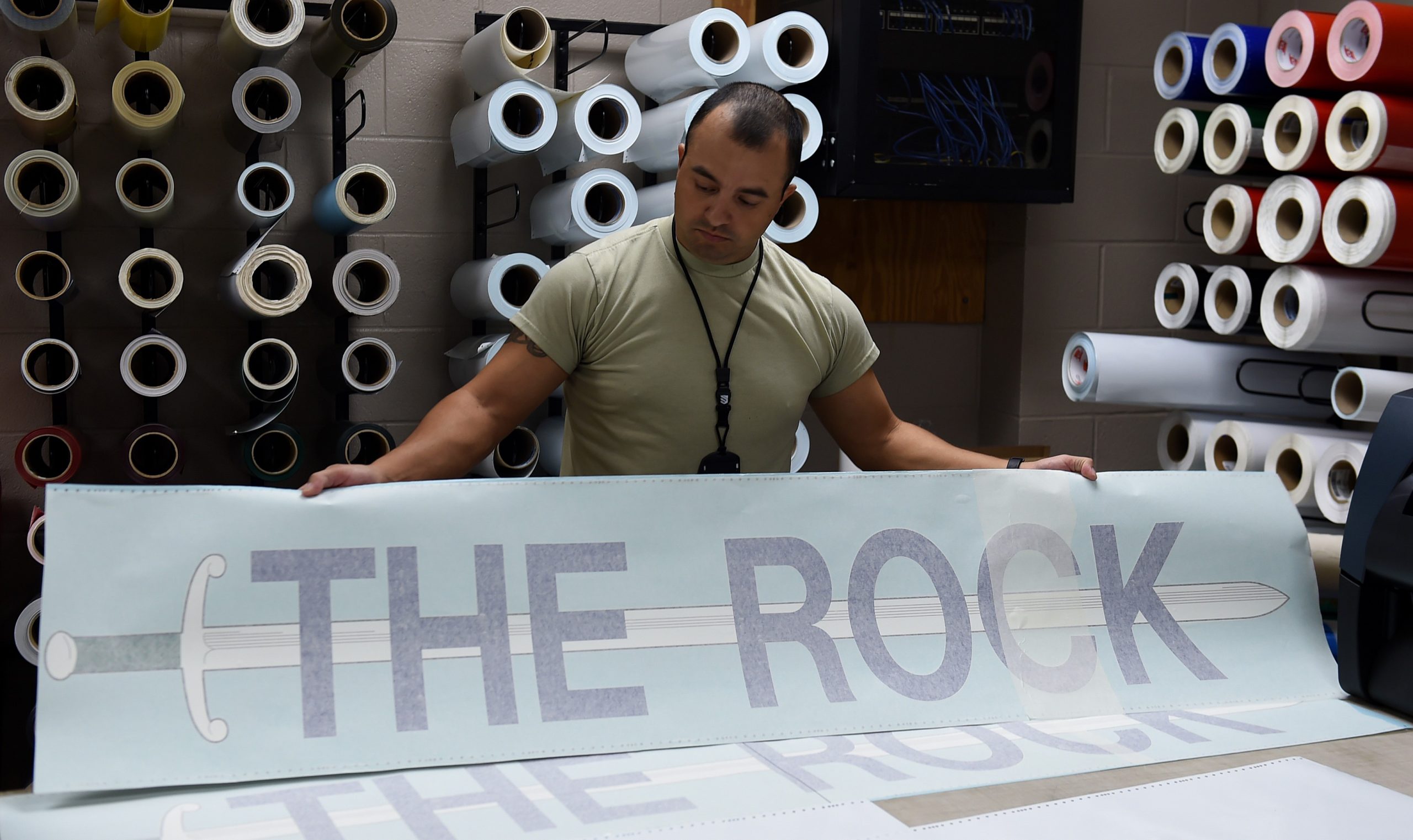
U.S. Air Force photo by Staff Sergeant Dana J. Cable, 26OCT2017.
October 2017, at Little Rock Air Force Base, Arkansas, a vinyl decal is readied for use as the new tail flash for the 314th Airlift Wing’s C-130Js.
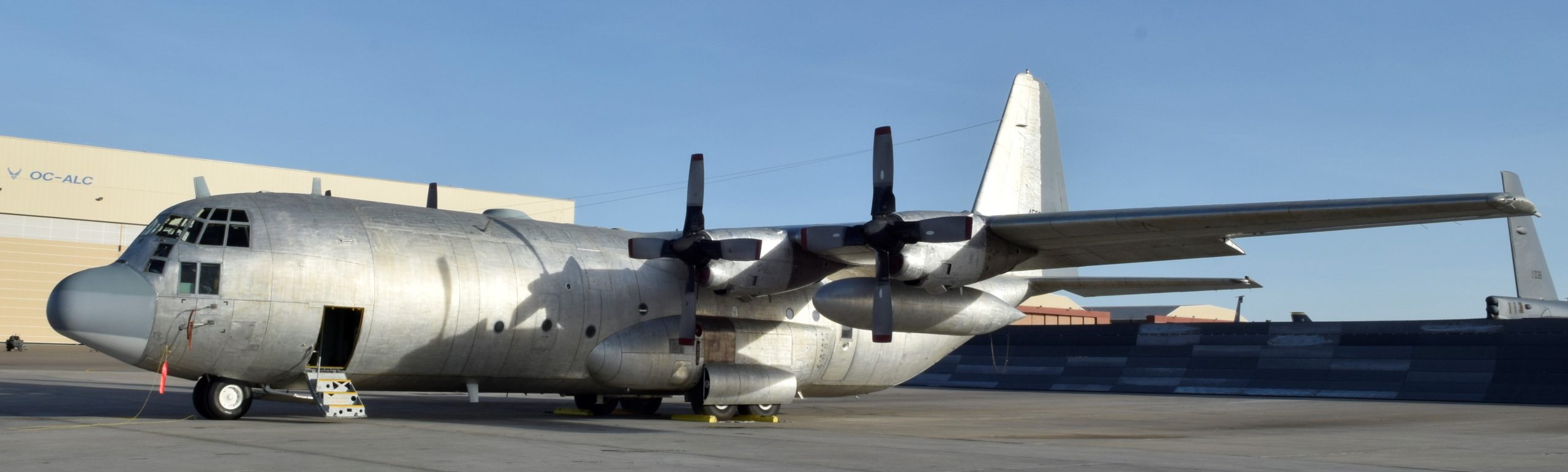
USAF photo by Greg L. Davis, 09FEB2017.
United States Marine Corps KC-130T sits at Oklahoma City (Tinker) Air Logistics Complex, waiting for new clothes, February 2017.
Oklahoma City Air Logistics video explainer:
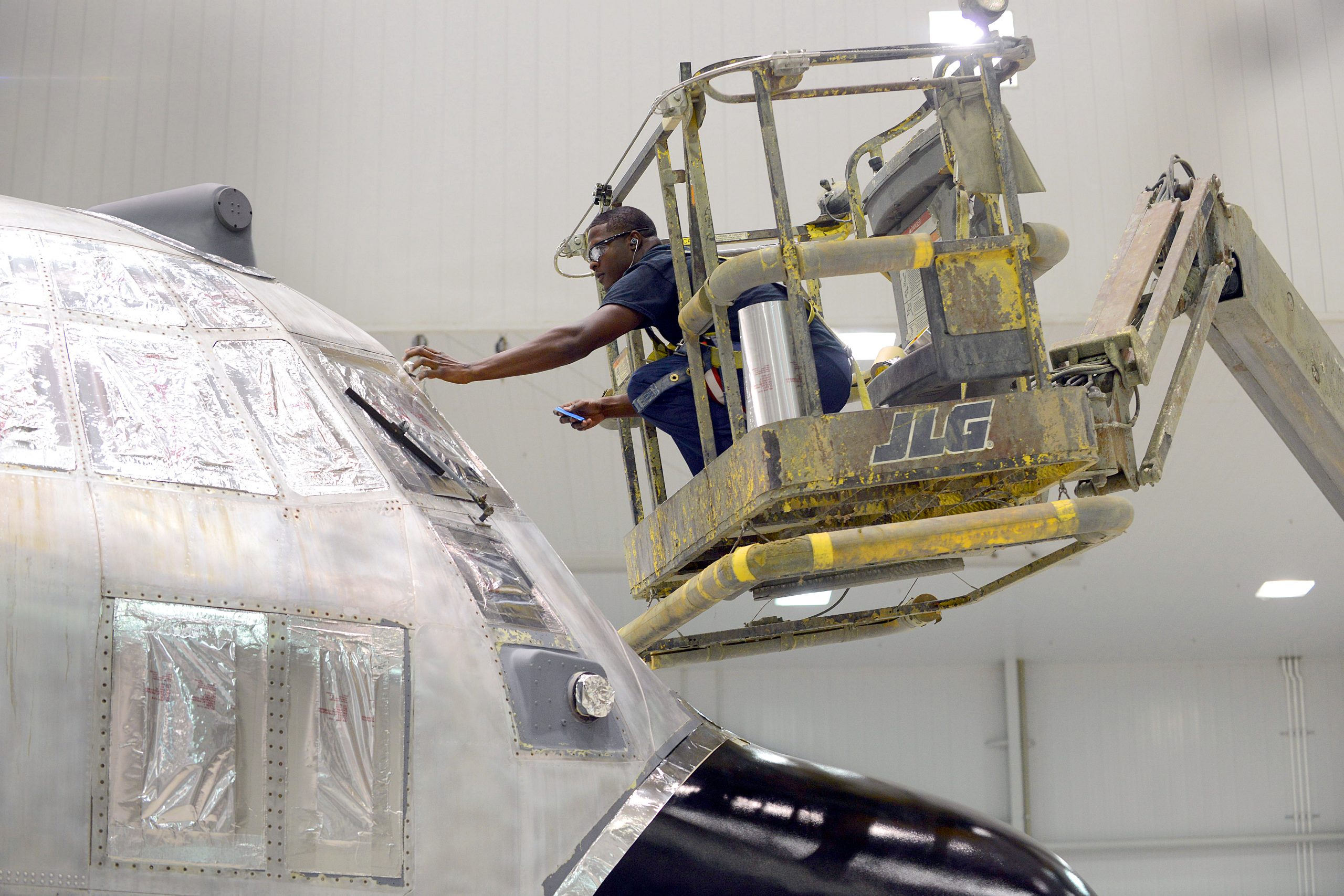
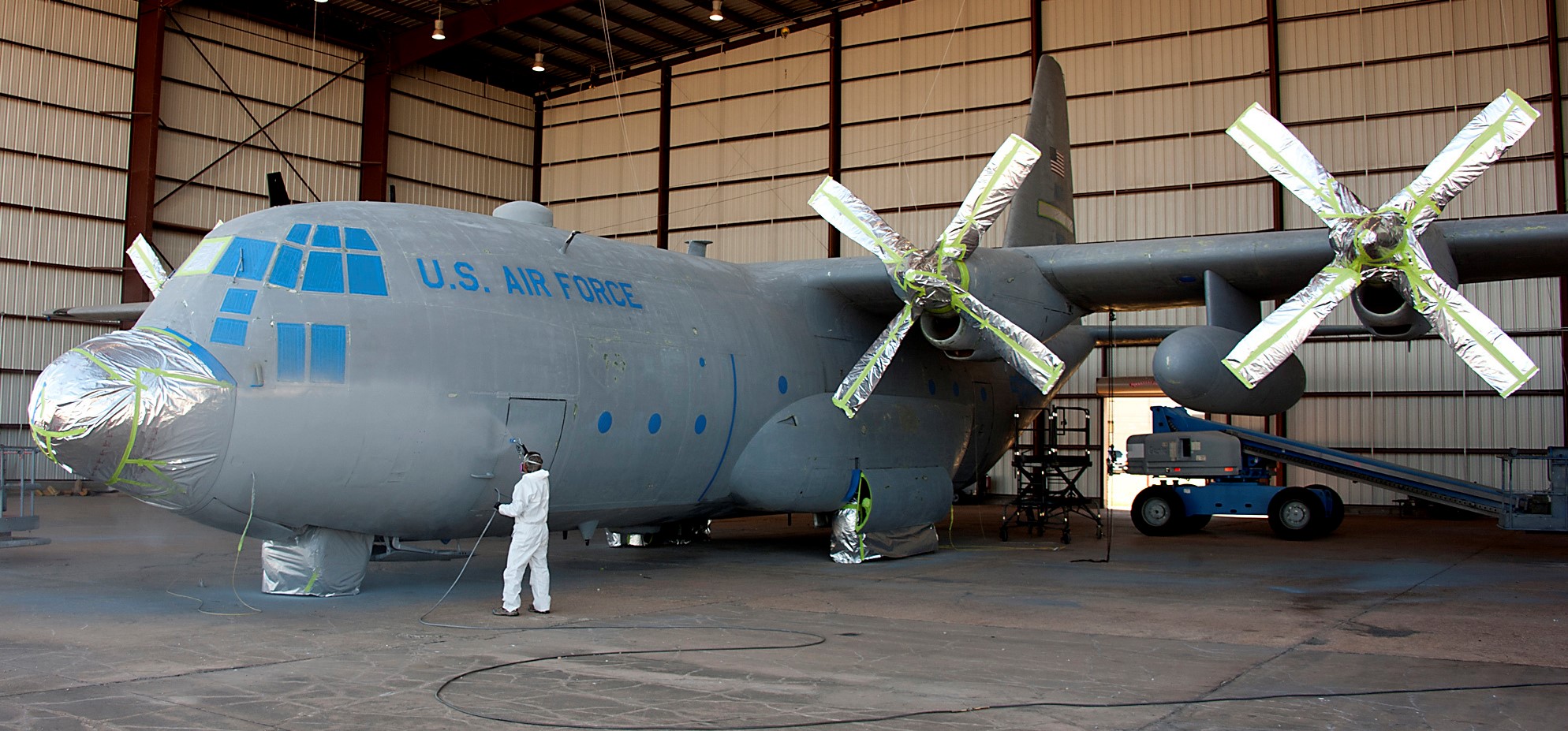
USAF photo by Tommie Horton, 27JUL2015.
Masking the windows of a C-130 for painting, July 2015, at the Warner Robins Air Logistics Complex, Georgia.
Warner Robins video explainer:
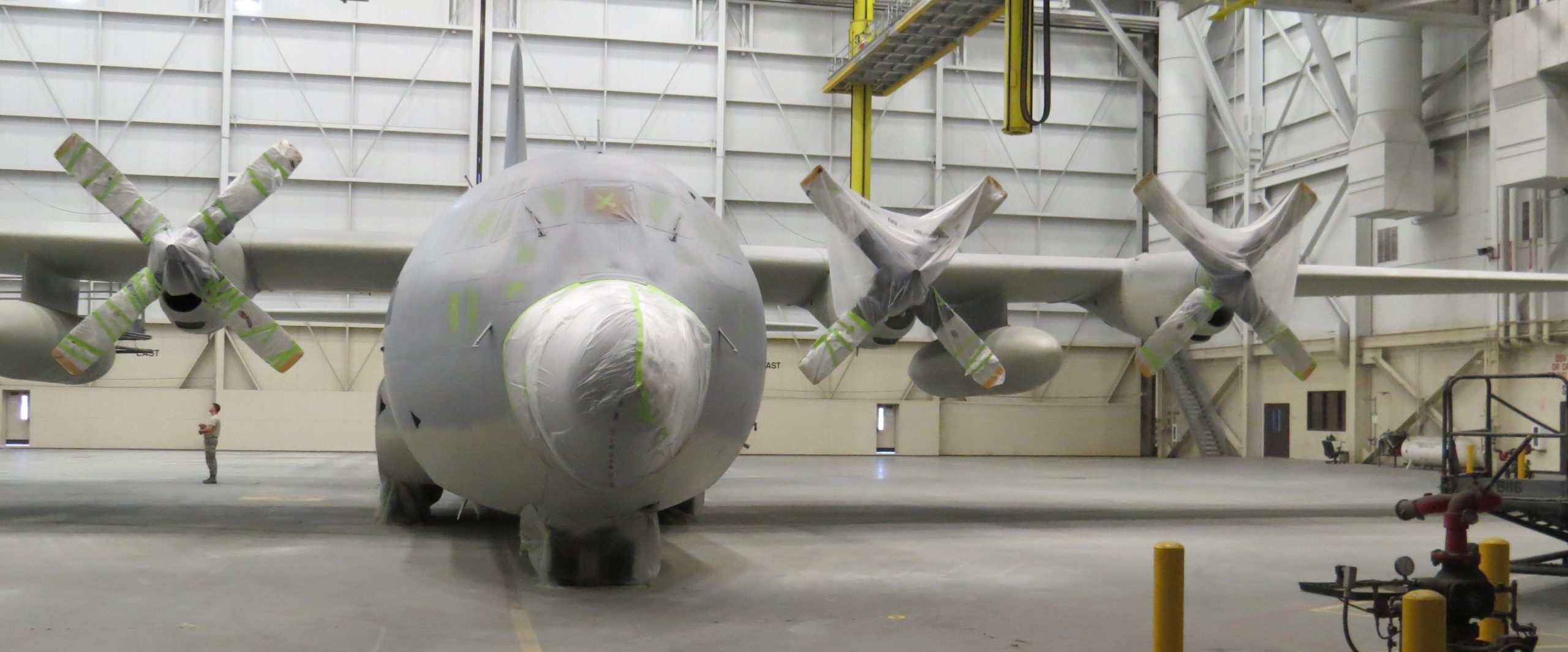
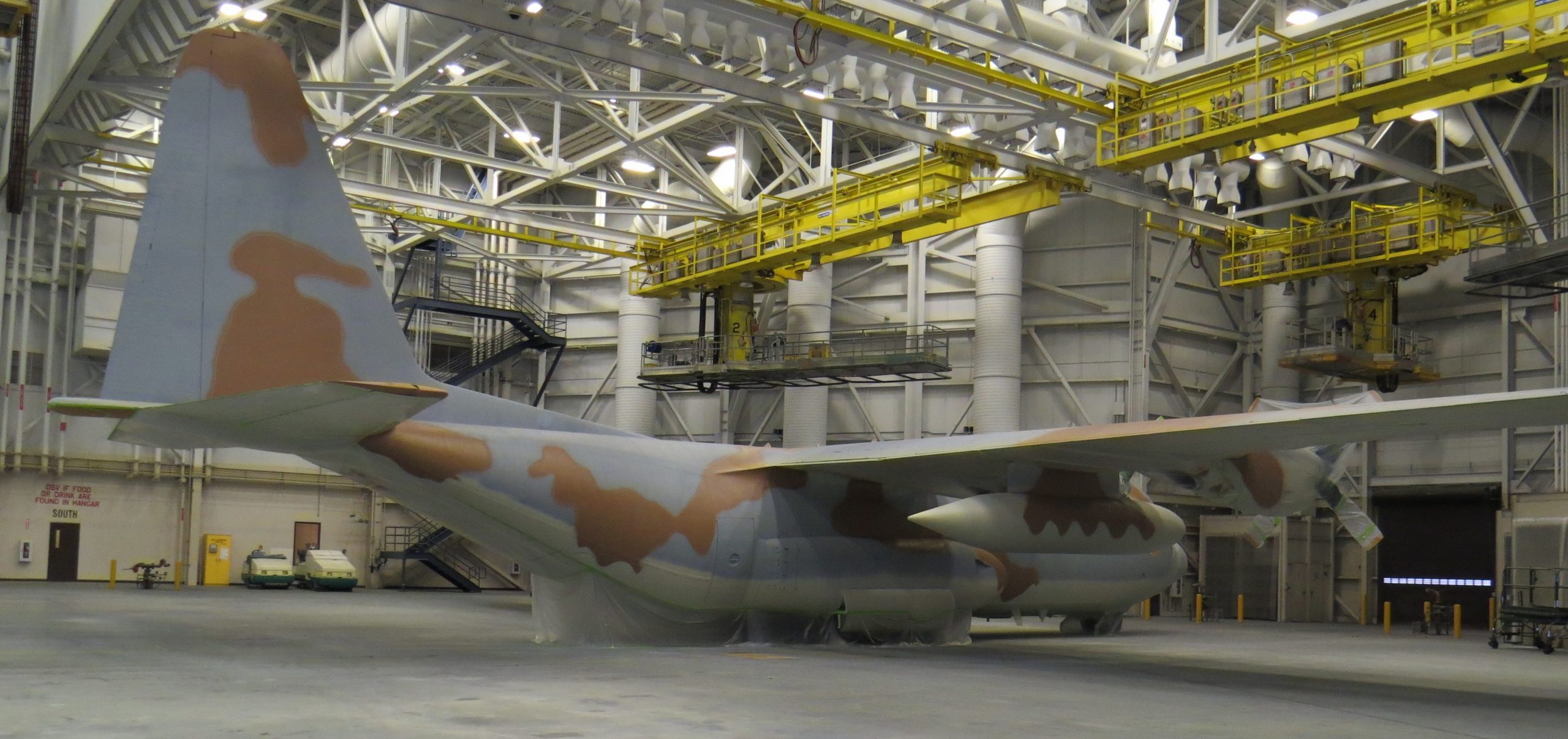
McChord Air Museum photo, 25NOV2014.
November 2014, McChord Air Museum, Washington, primer paints C-130 for static display.
McChord Air Museum photo, 10DEC2014.
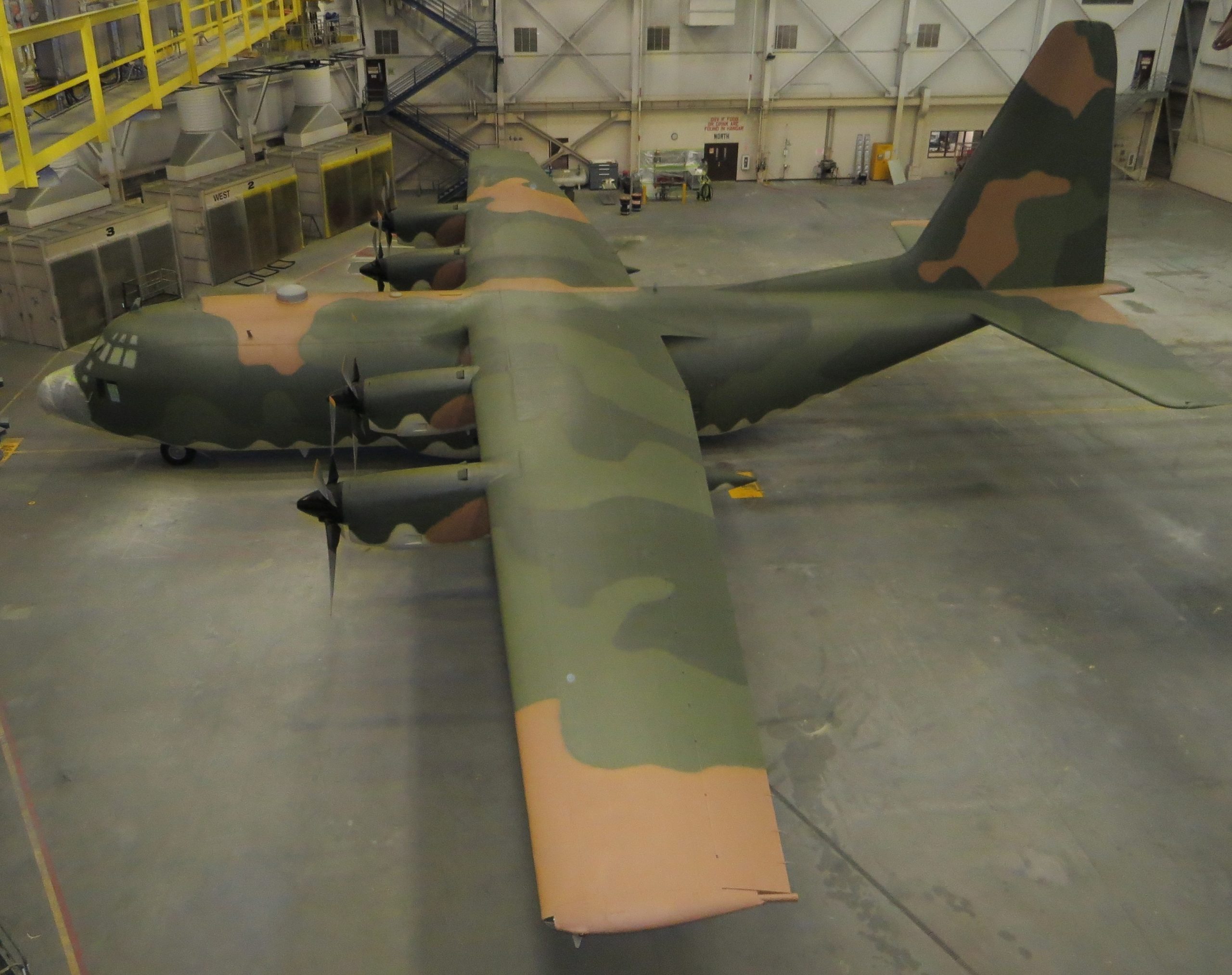
McChord Air Museum photo, 08JAN2015.
It took two months but finally, in January 2015, McChord Air Museum’s Vietnam era C-130 is almost ready for display.
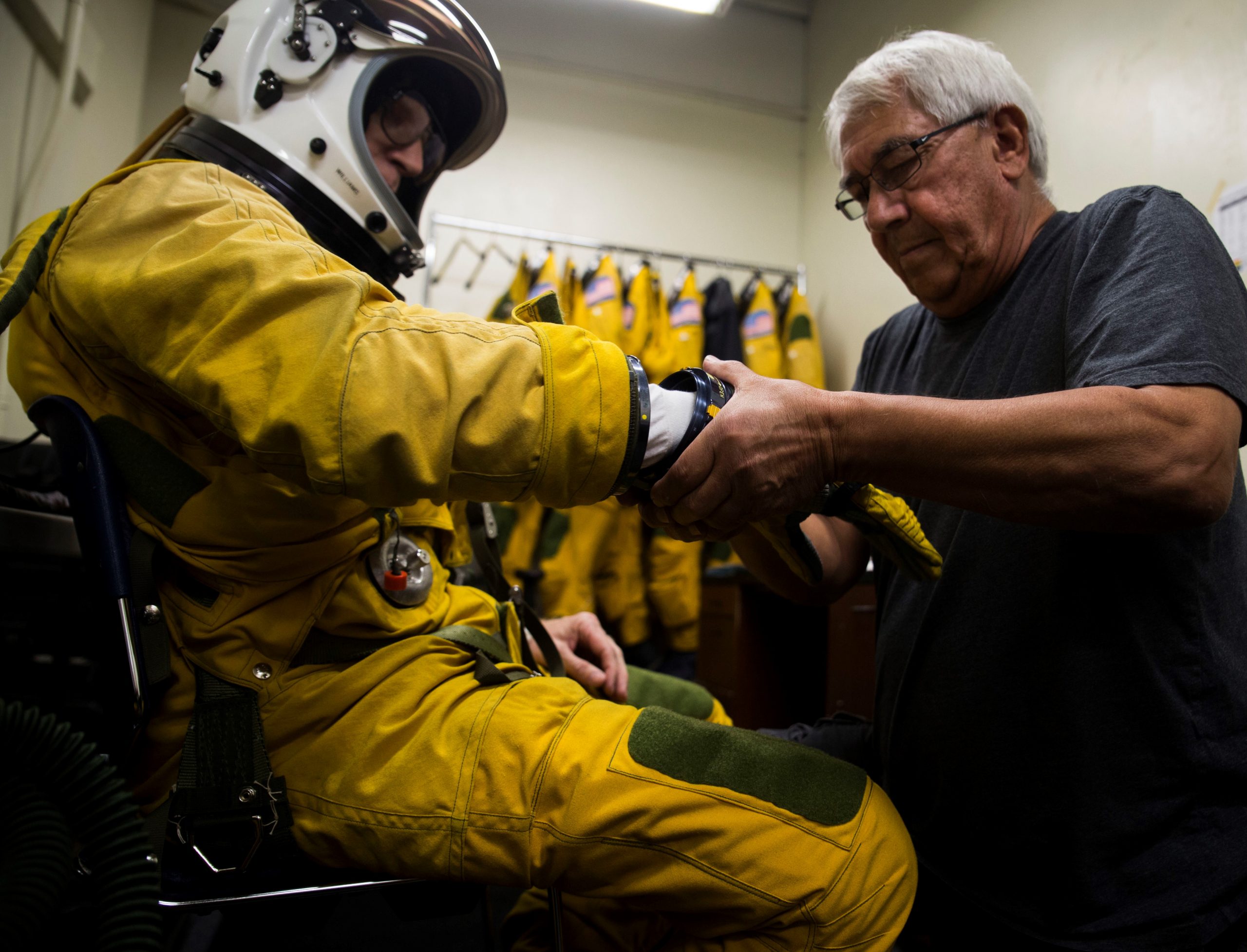
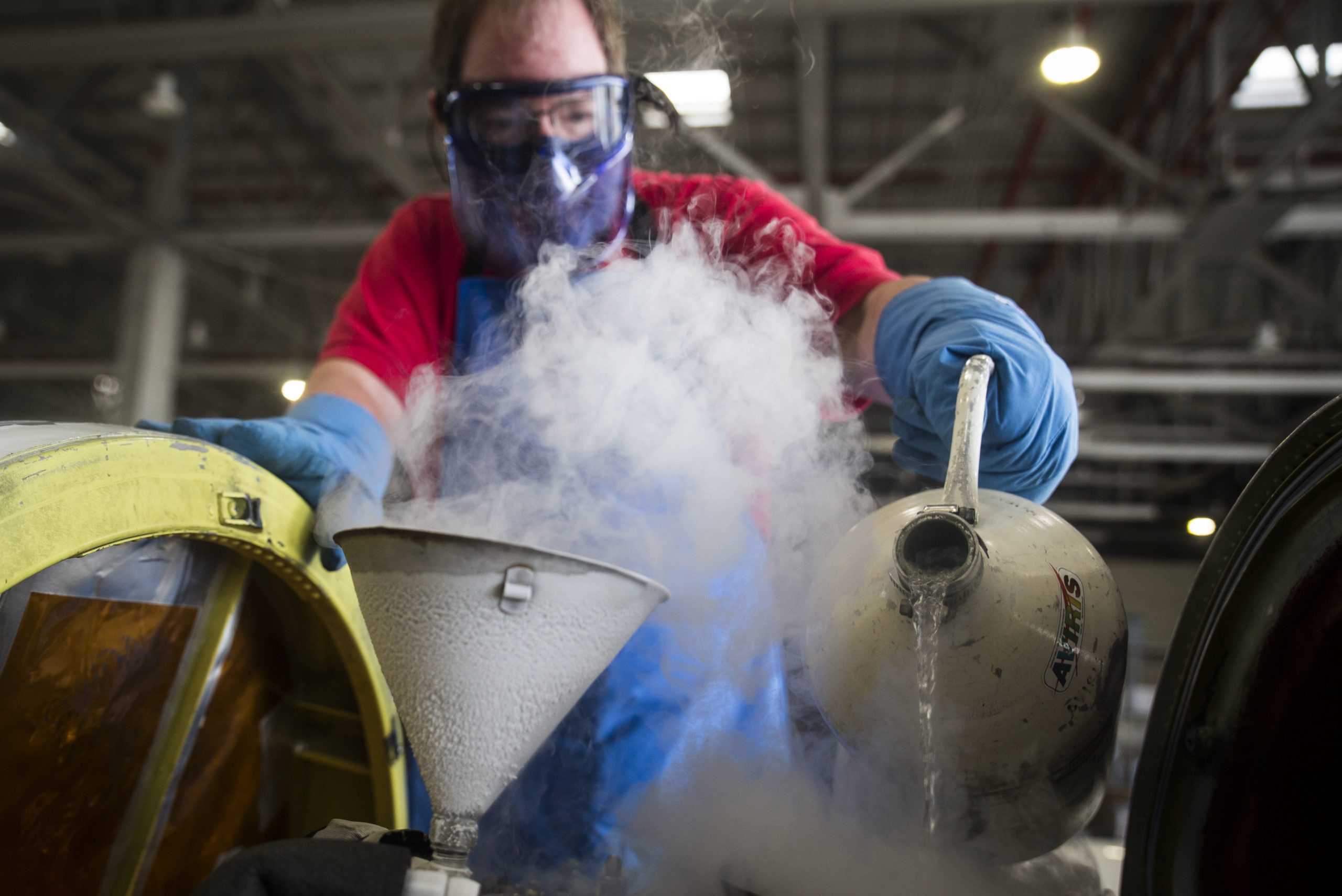
NASA pilot suits-up for an ER-2 AVIRIS-NG mission high over Hawaii, February 2018. U.S. Marine Corps photo by Lance Corporal Luke Kuennen.
Six decades after California set the first global standards for industrial anti-air-pollution laws the National Aeronautics Space Administration (NASA) has proven those (and subsequent) laws to be laughable.
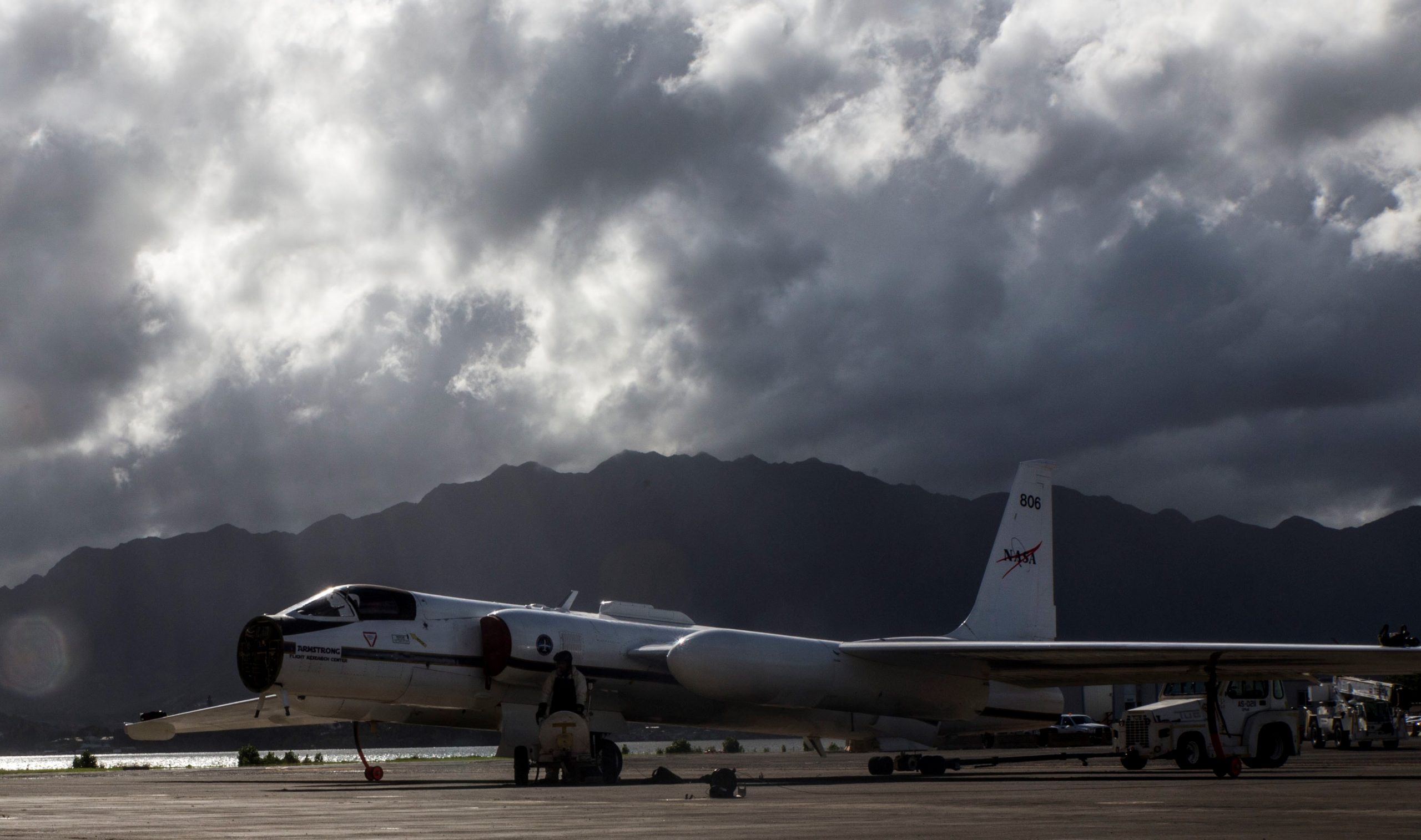
NASA ER-2 preps for a mission from Marine Corps Air Station Kaneohe Bay, Hawaii, February 2018. USMC photo by Lance Corporal Luke Kuennen.
NASA used it’s modified U-2R/TR-1A, called the ER-2 (Earth Resources-2), to inspect industrial air pollution, scanning the ground from near-space (65-thousand feet/19-thousand-812 meters): “Before the pilots even take off, we put them on 100% oxygen for an hour to get all of the nitrogen out of their systems. It’s similar to what scuba divers can face. If they have nitrogen in their system, they can end up getting what they call the bends, and it’ll be a really bad day for that pilot.”-Wason Miles, ER-2 life support crew, from 2018 interview concerning the HyspIRI preparatory airborne mission over Hawaii
Liquid nitrogen is used to cool the ER-2’s hyperspectral thermal emission spectrometer. USMC photo by Lance Corporal Luke Kuennen.
The two years long NASA-California methane mission resulted in the AVIRIS-NG ( Airborne Visible InfraRed Imaging Spectrometer-Next Generation) system, onboard the ER-2, discovering dozens of what NASA calls methane “super-emitters”(published 06NOV2019) across the Los Angeles area. This why I say California’s progressively ‘tougher’ anti-pollution laws failed. I lived in California when those anti-pollution laws began driving out many industries causing the loss of thousands of jobs just in the Los Angeles area, in the 1970s-80s. The exalted lawmakers of The Golden State then started playing games with their own anti-pollution laws, trying to woo back major employers. NASA’s California methane mission revealed that the industrial sector of the Los Angeles area is still pumping out clouds of pollution, even with stricter air quality laws and fewer industrial operations.
NASA photo by Jim Ross, 13JUL2006.
Boring 2018 lecture type NASA explainer video about how AVIRIS detects and maps methane emissions:
NASA photo by Lori Losey, August 2001.
2017 NASA video explainer of their climate-spy-plane AVIRIS system:
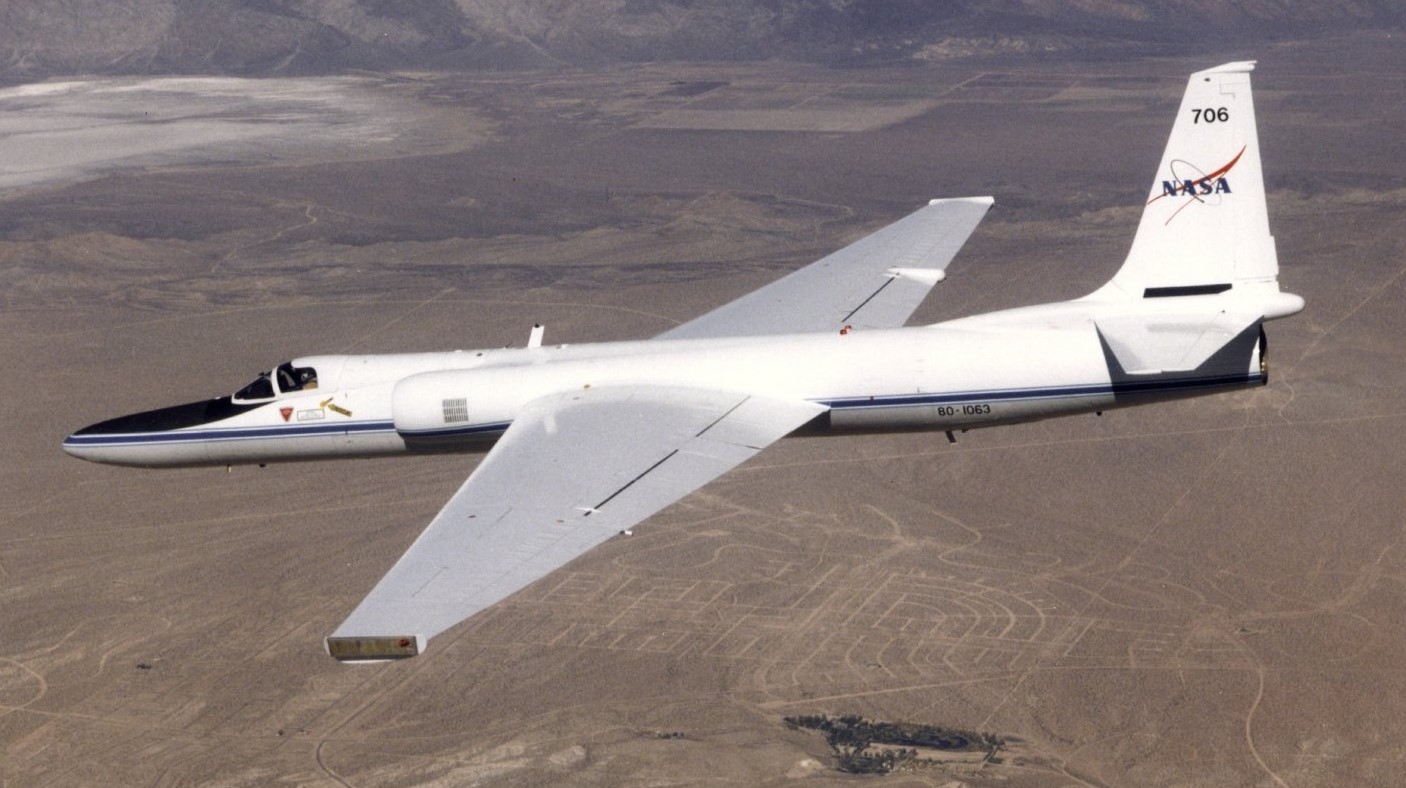
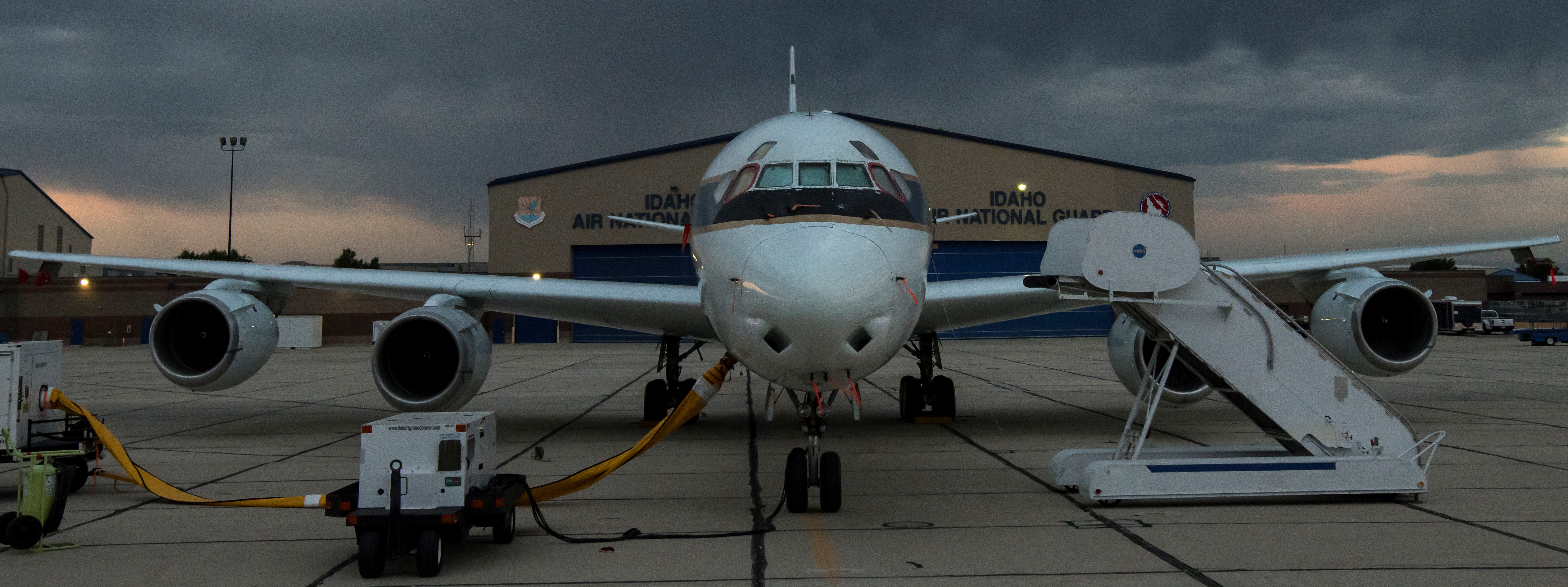
ER-2 tail#706, over Edwards AFB, California, 04NOV1997. NASA photo by Carla Thomas.
In the 1990s, NASA had three ER-2s, but now has two. The other ER-2 was returned to the U.S. Air Force.
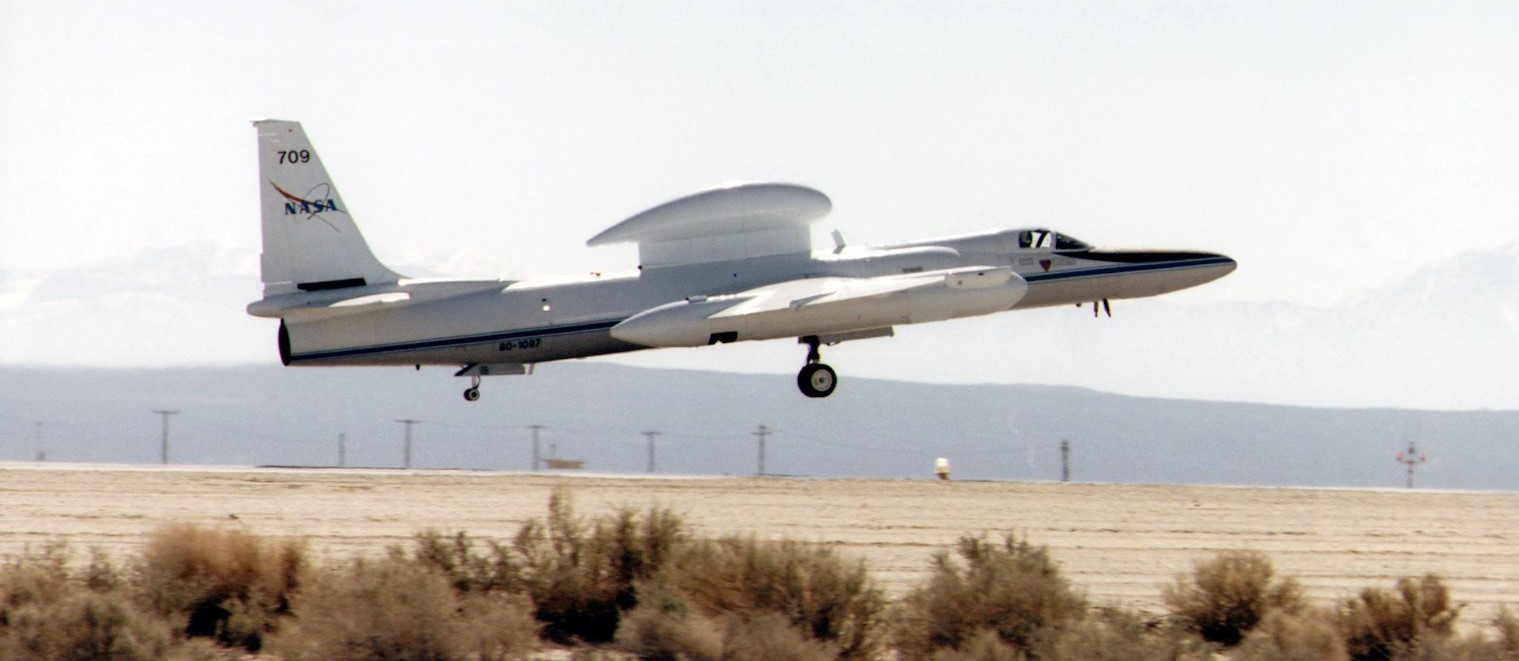
ER-2 tail#709. NASA photo by Tony Landis, 18FEB1998.
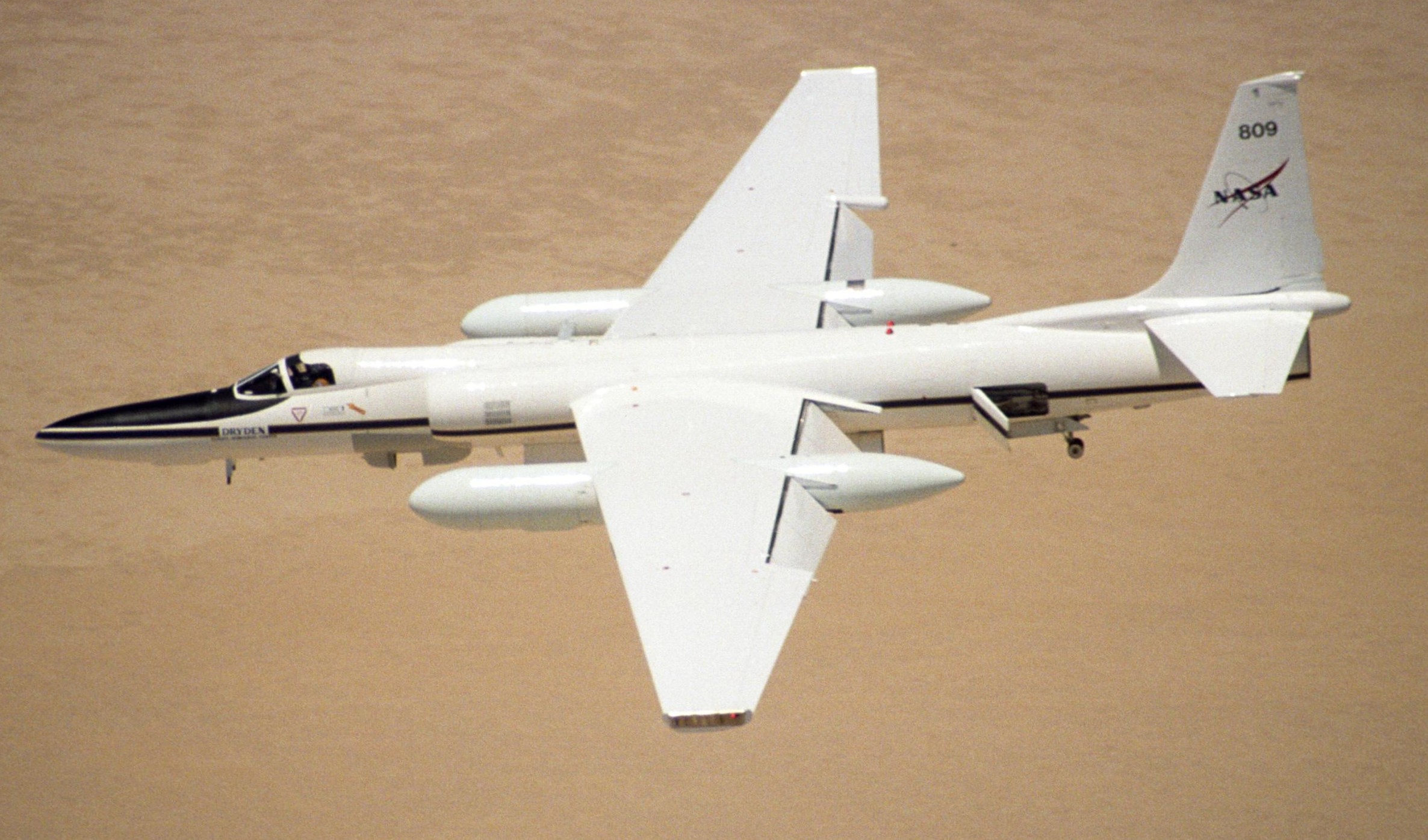
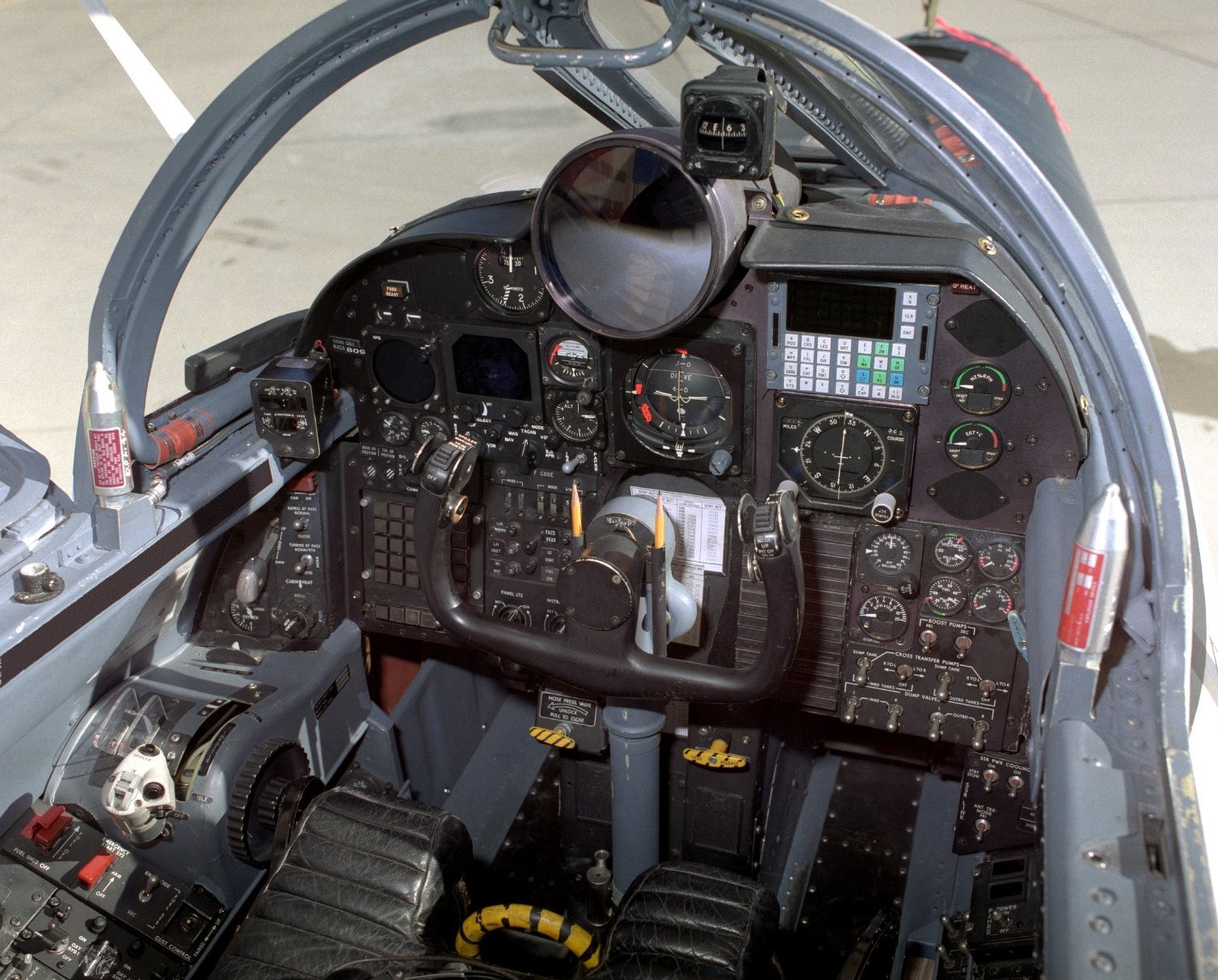
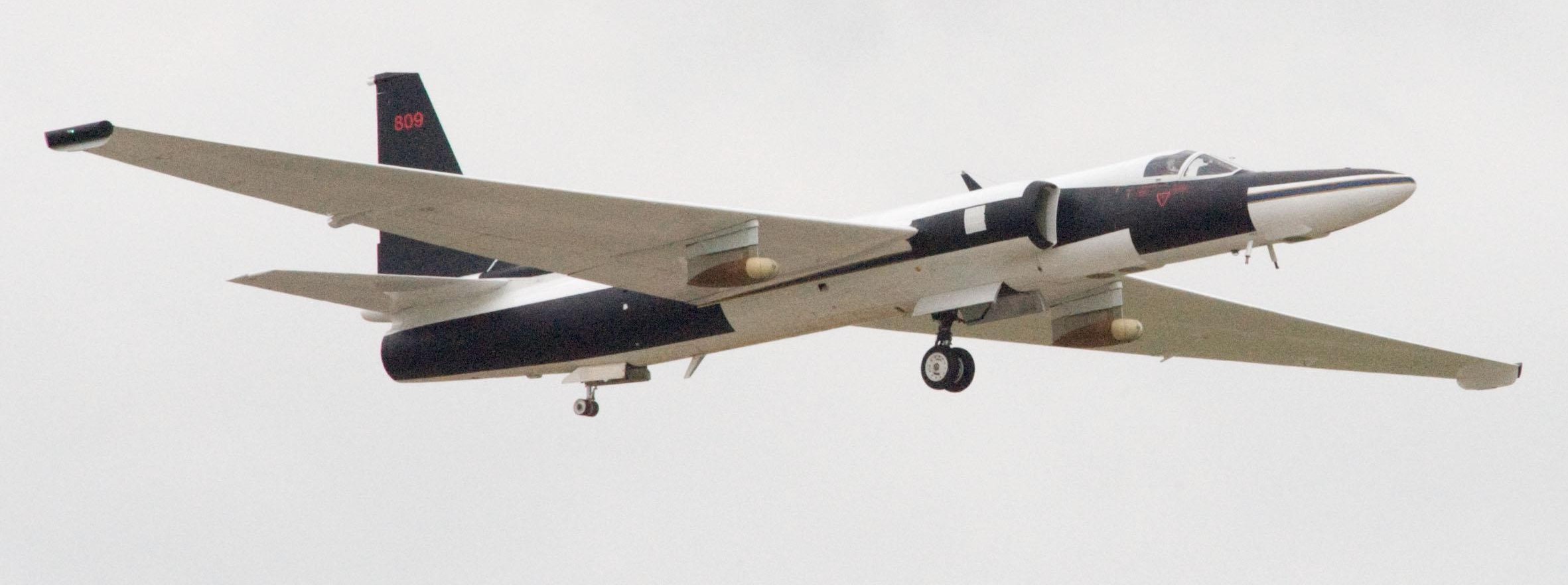
Lockheed ER-2 tail#809 cockpit. NASA photo by Tony Landis, 11DEC1999.
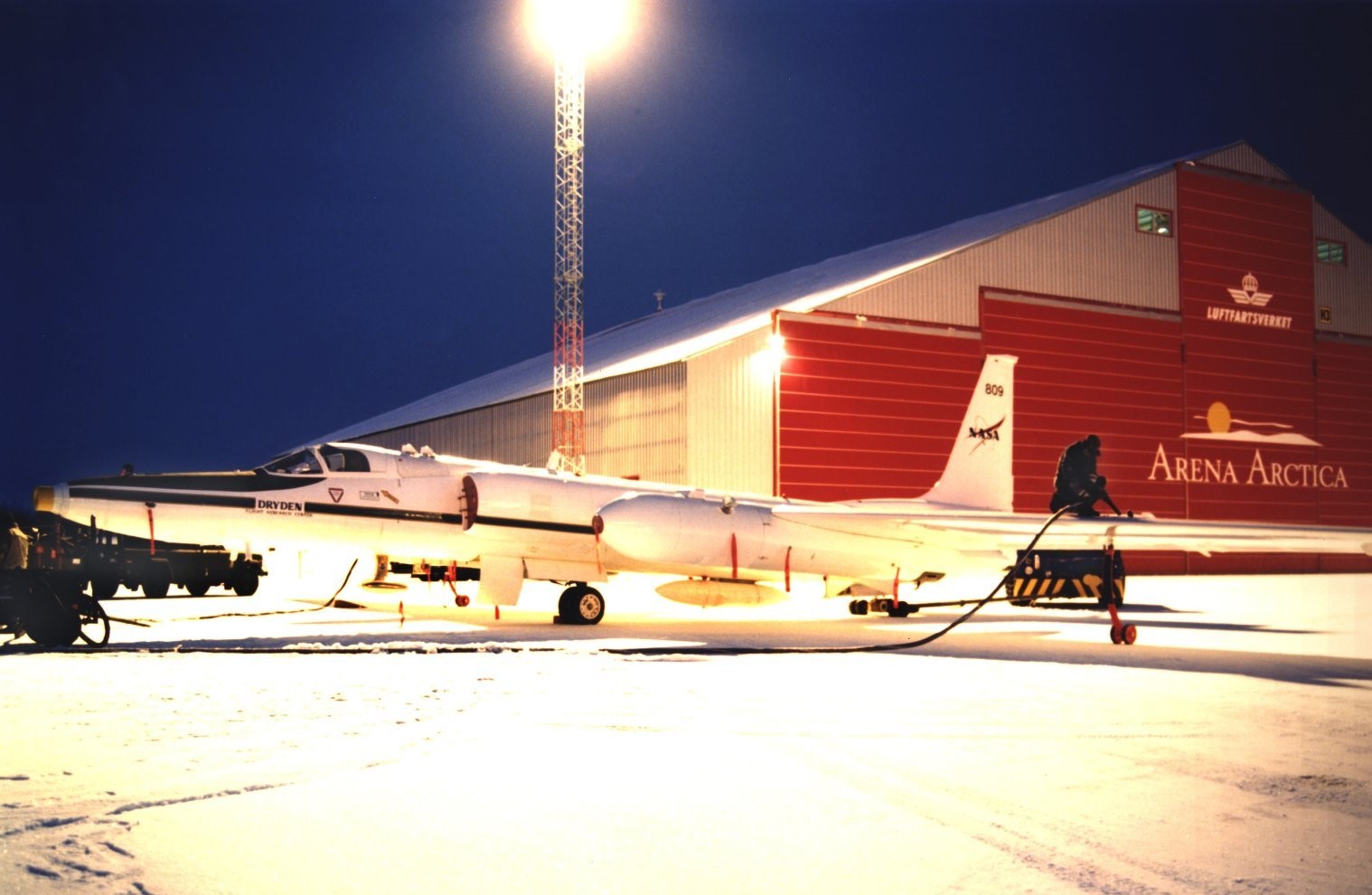
ER-2 #809 receives fuel outside Arena Artica hangar in Kiruna, Sweden. SAGE-3 Ozone Loss & Validation Experiment (SOLVE), January 2000. NASA photo by Jim Ross.
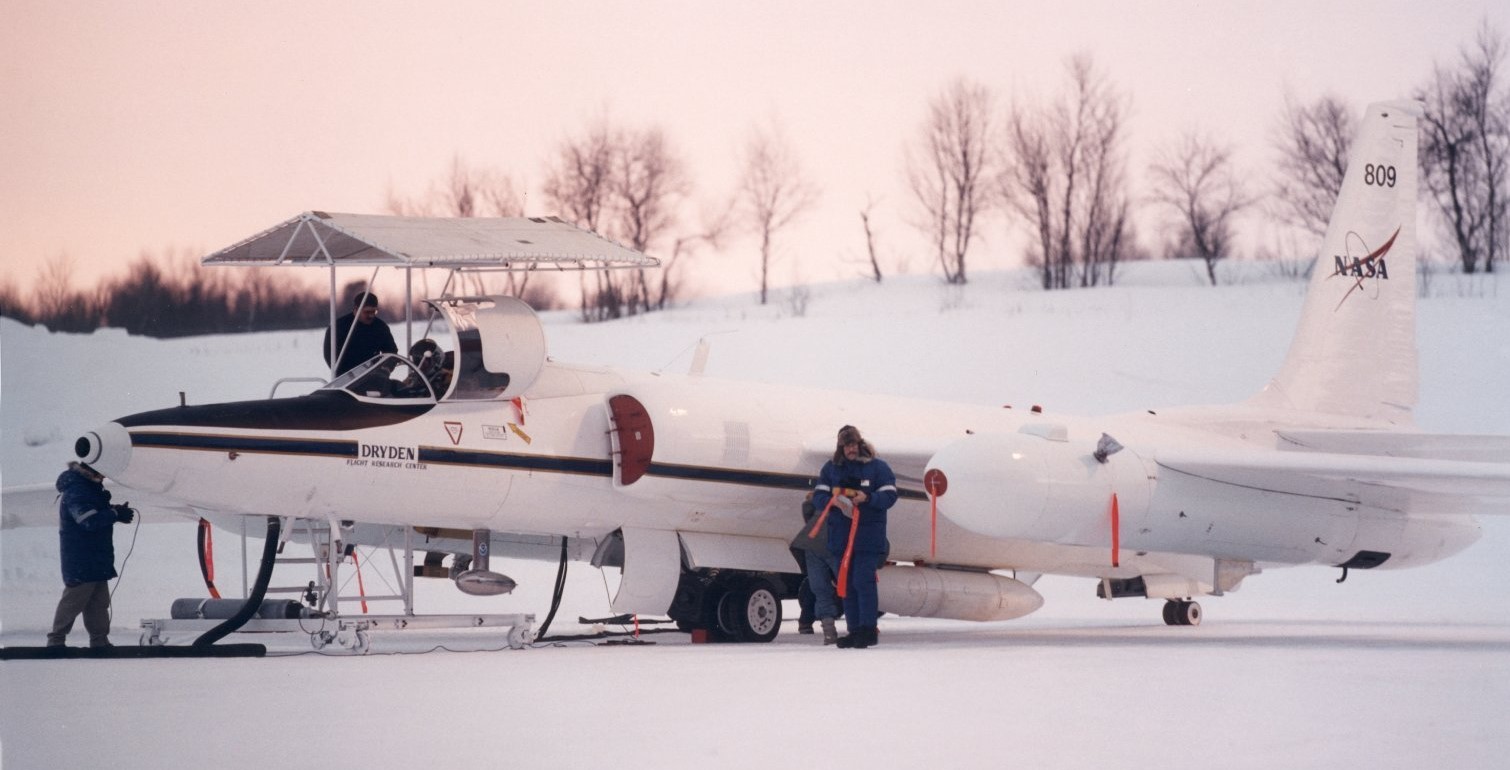
ER-2 #809 in Kiruna, Sweden for SAGE-3 Ozone Loss & Validation Experiment (SOLVE), January 2000. NASA photo by Jim Ross.
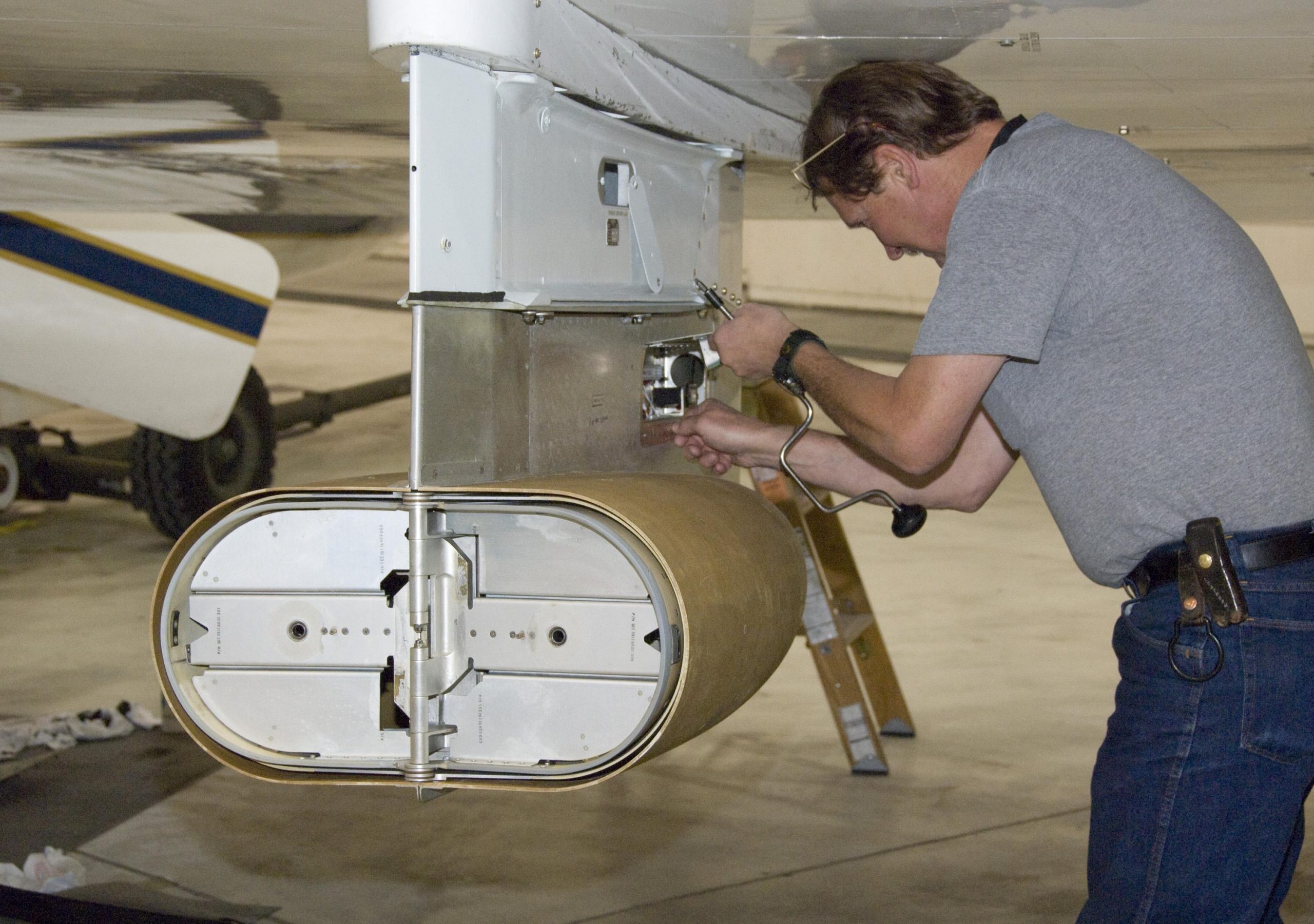
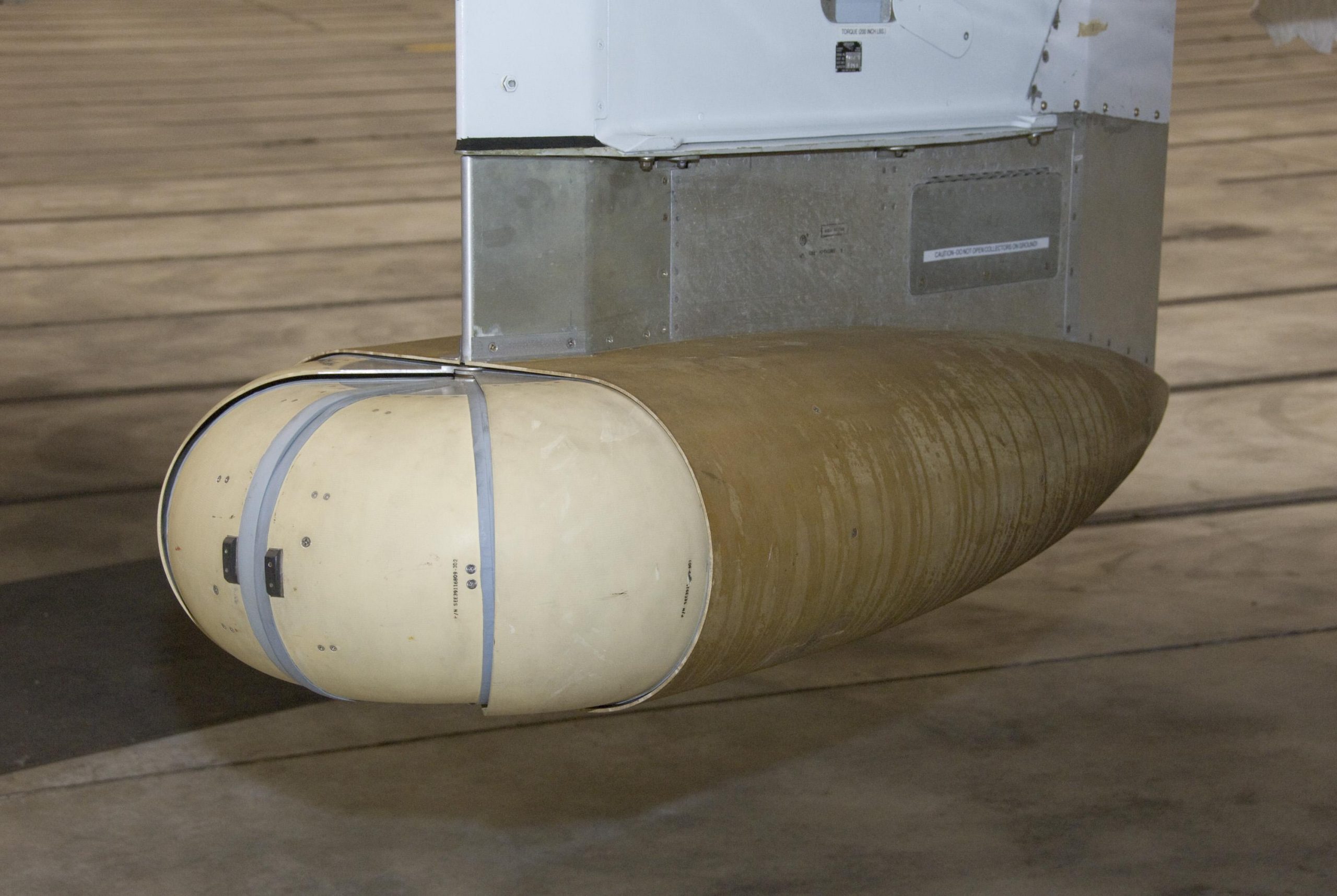
The ER-2, which has been in use for decades, can be equipped with a variety of sensors.
Large Area Collector sensor for a cosmic dust collection. NASA photo by Tom Tschida, 24APR2009.
ER-2 under-wing mounted cosmic dust collector pod. NASA photo by Tom Tschida, 24APR2009.
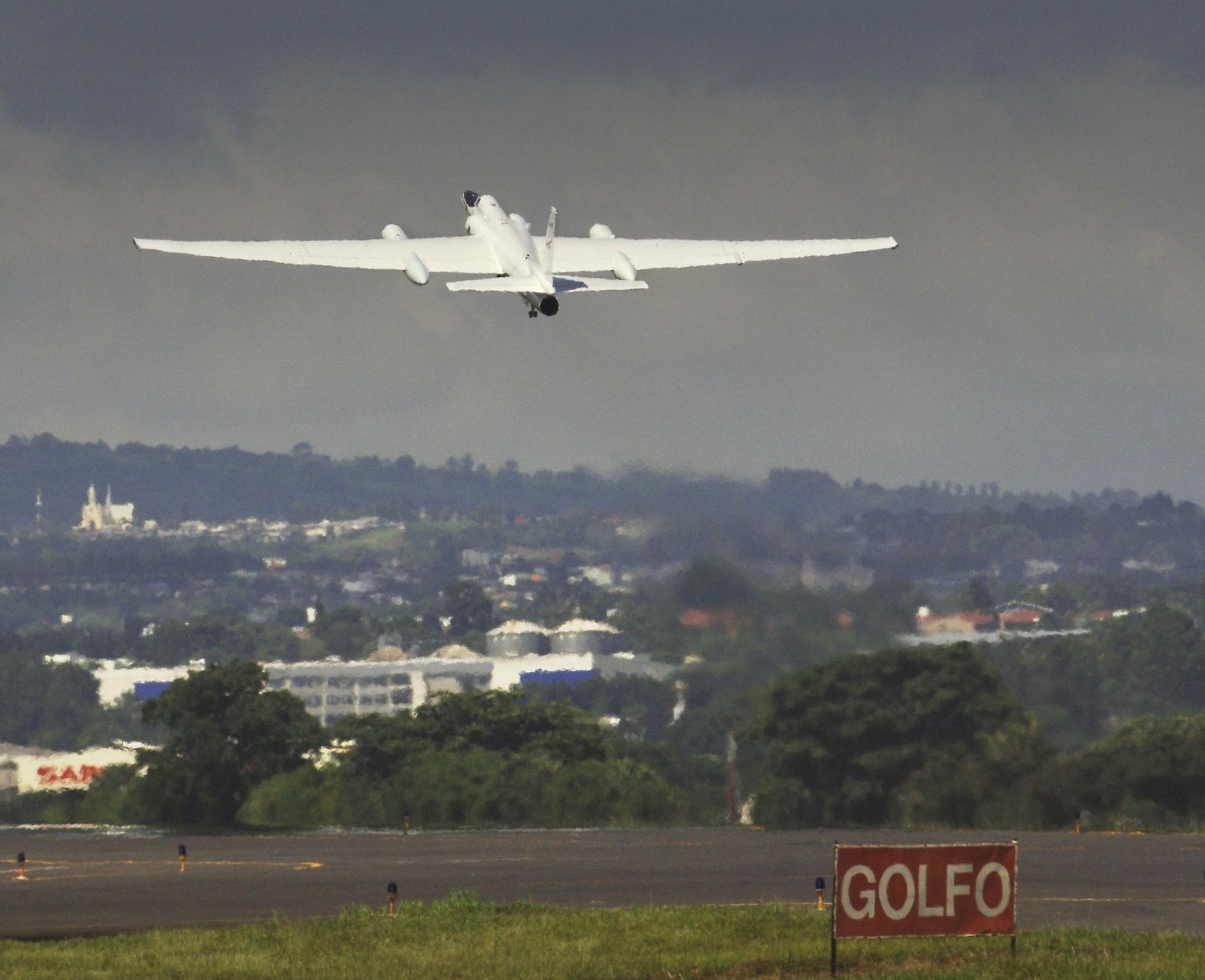
ER-2 Tropical Cloud Systems and Processes (TCSP) mission over Costa Rica, 06JUL2005. NASA photo by Bill Ingalls.
May 2010 pic of NASA’s ER-2 overflying the British Petroleum’s Deepwater Horizon Gulf of Mexico oil spill. NASA photo by Regan Geeseman.
Incomplete (tip-o-the iceberg) list of main-stream-news links about global immigrant/border operations affecting the United States taxpayers, October 2019.
Somewhere in the eastern Pacific, 11OCT2019, U.S. Coast Guard personnel pose on top of the drug smuggling submarine they captured. During an eight week period the Coast Guard captured 11 smugglers and an estimated U.S.$216-million worth of illegal drugs.
Security cam video of vehicle illegally crossing from Canada into U.S. (near Lynden), seven illegals from British-empire’s United Kingdom were captured by Border Patrol, 02OCT2019:
27 October 2019 (13:09 UTC-07 Tango 06) 05 Aban 1398/27 Safar 1441/29 Jia-Xu 4717
Real short thermal image video of 27OCT2019 X-37B landing:
“The sky is no longer the limit for the Air Force and, if Congress approves, the U.S. Space Force.”-General David L. Goldfein, U.S. Air Force
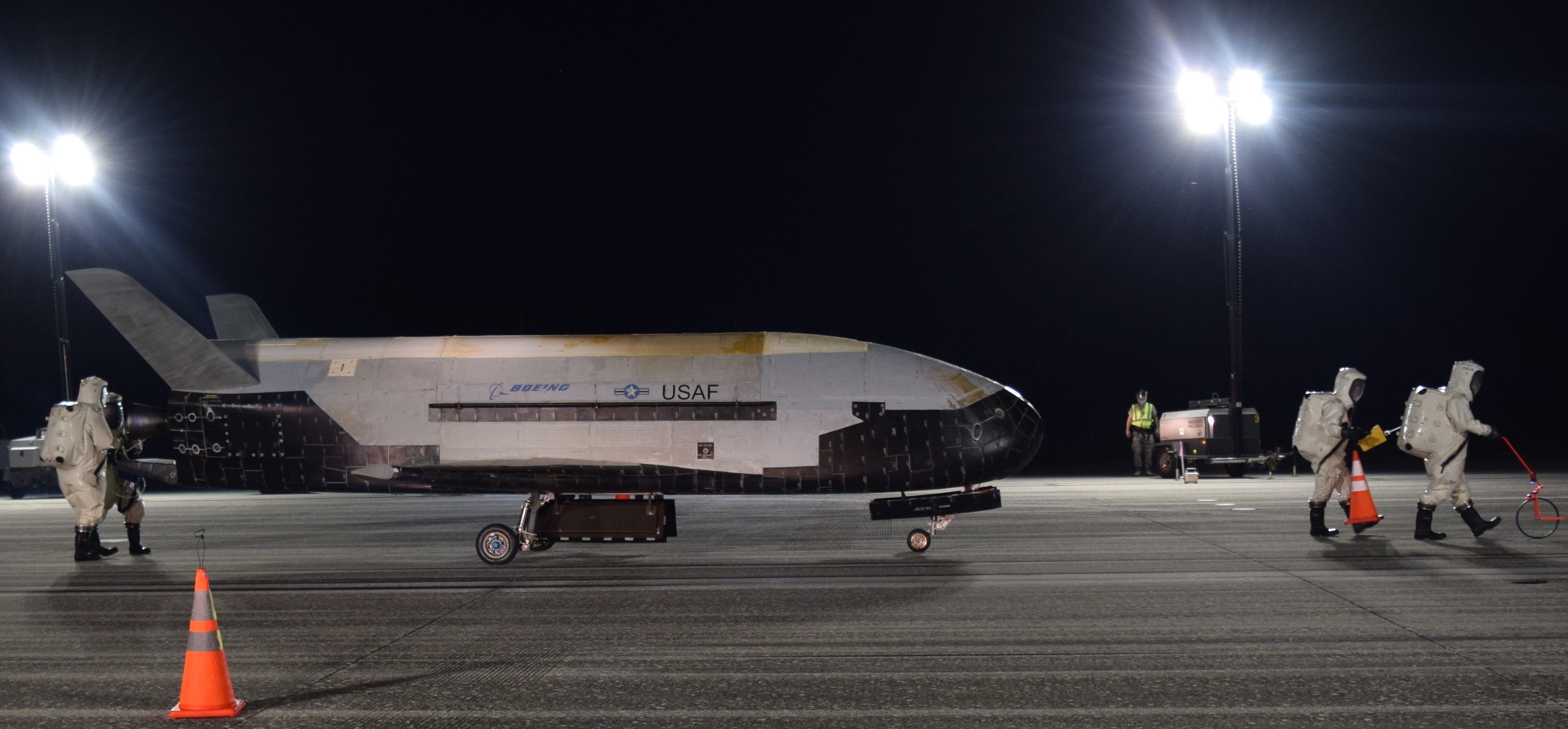
After two years in orbit, the space drone X-37B returned to Earth, setting a record: “The X-37B continues to demonstrate the importance of a reusable spaceplane. Each successive mission advances our nation’s space capabilities.”-Barbara Barrett, Secretary of the Air Force
Photo via Space Launch Delta 45.
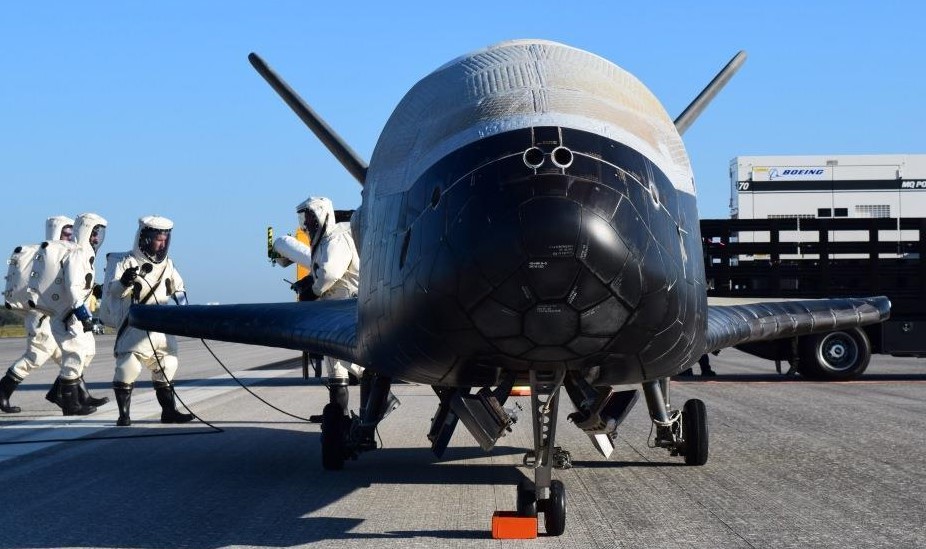
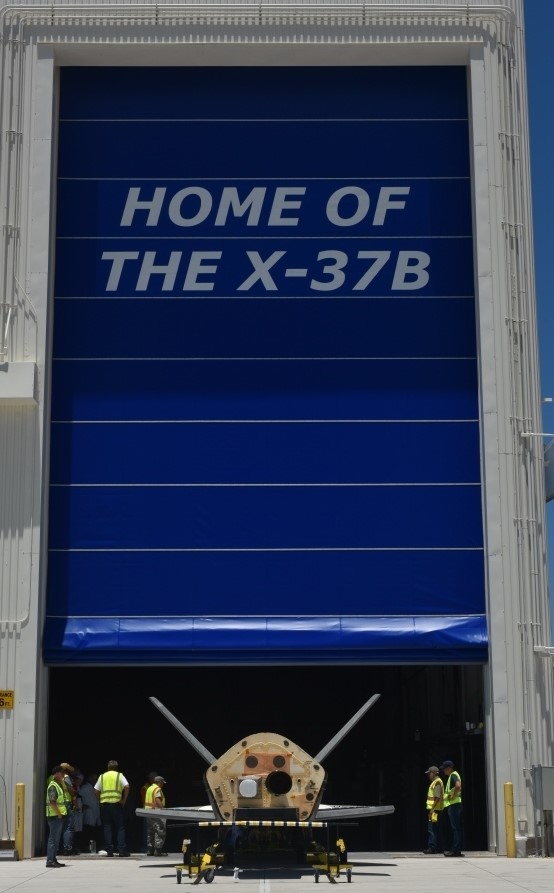
At 03:15 Eastern U.S. Time, 27OCT2019, the Orbital Test Vehicle (OTV) landed at NASA’s Kennedy Space Center in Florida, completing 780 days in orbit during its fifth test mission: “This program continues to push the envelope as the world’s only reusable space vehicle. With a successful landing today, the X-37B completed its longest flight to date and successfully completed all mission objectives. This mission successfully hosted Air Force Research Laboratory experiments, among others, as well as providing a ride for small satellites.”-Randy Walden, Air Force Rapid Capabilities Office
You should keep in mind how significant the 780 days in orbit are, as the Boeing X-37B was originally designed for only 270 day-orbits.
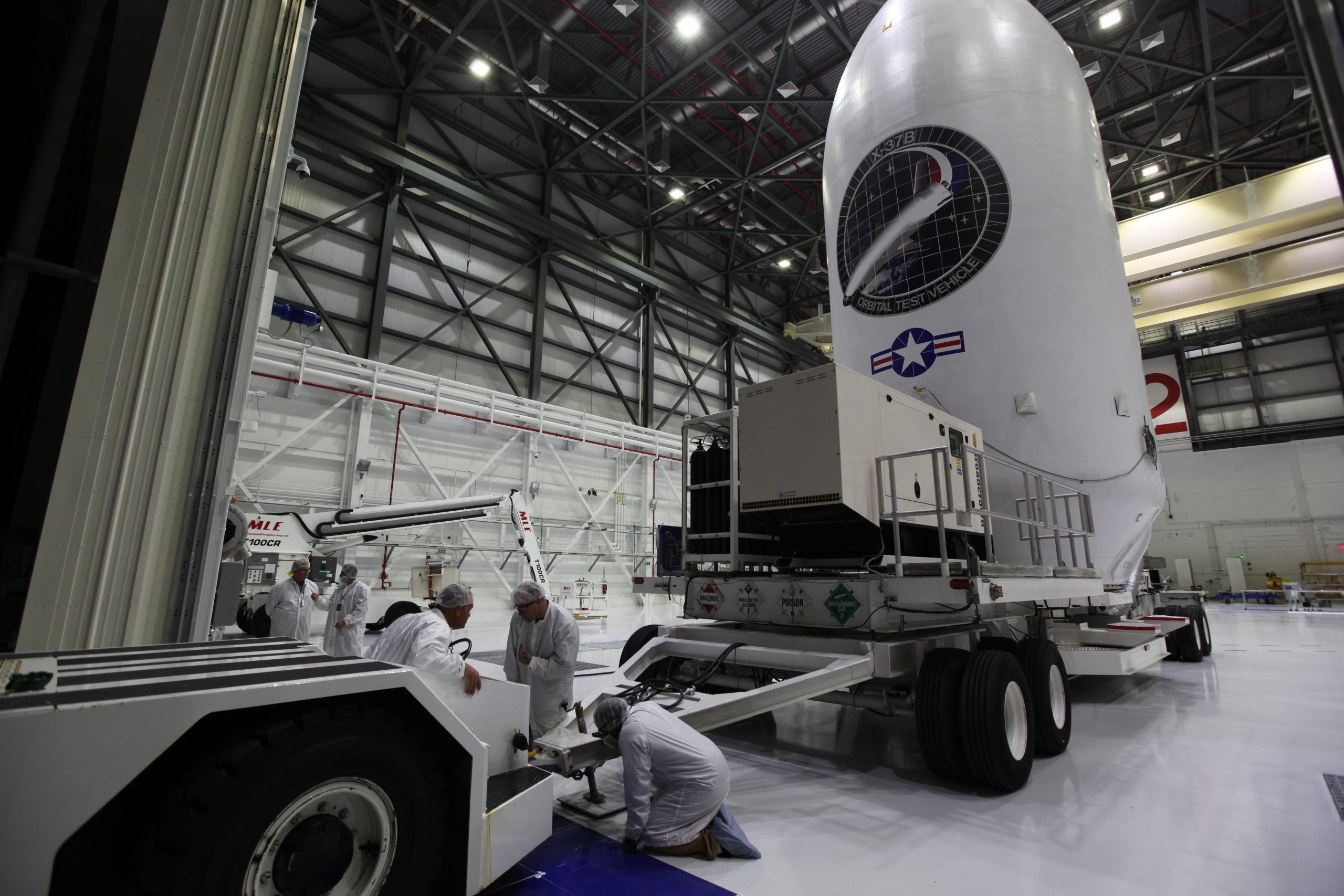
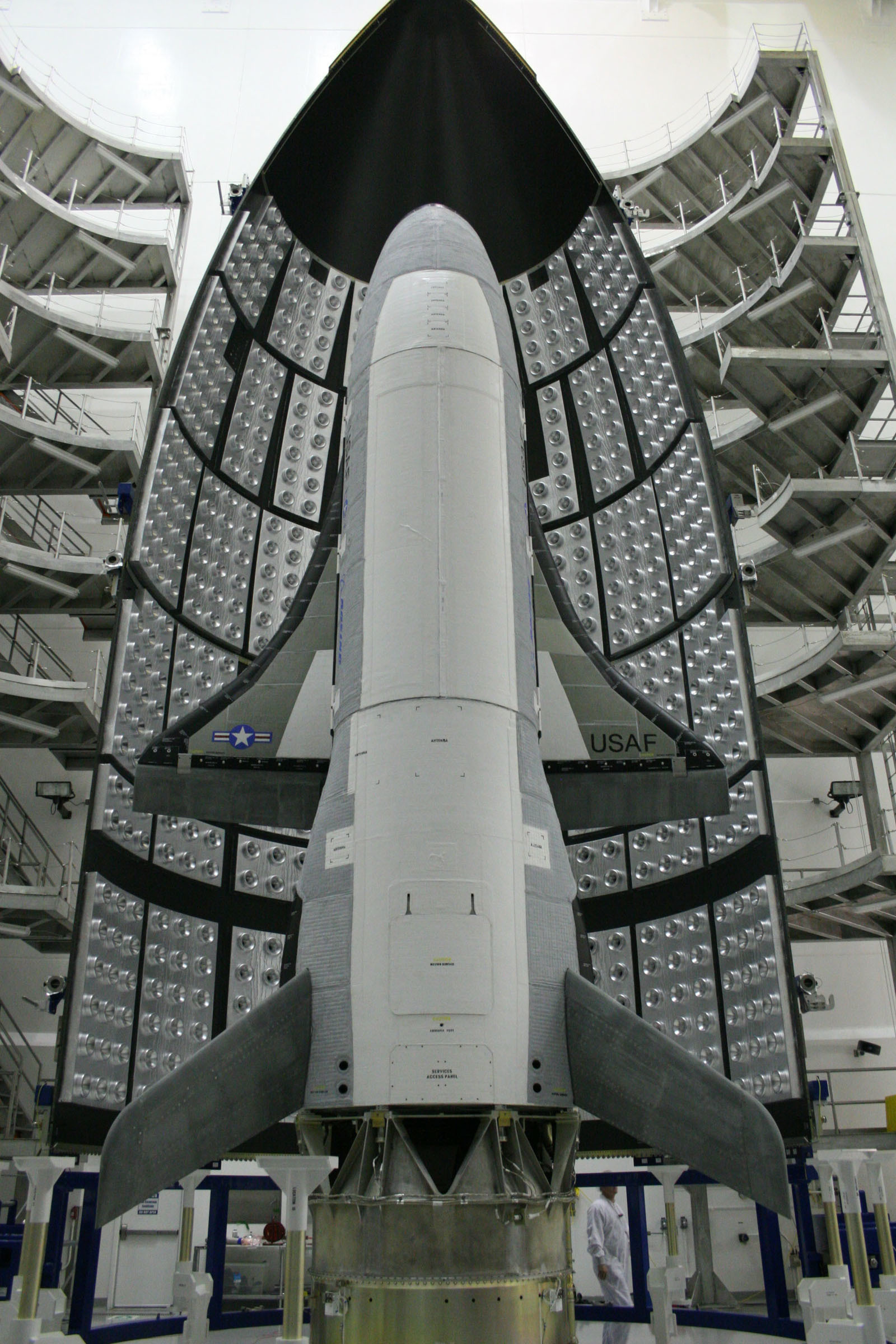
The X-37B OTV is placed inside a pod for launching, 31AUG2017. Photo via Boeing.
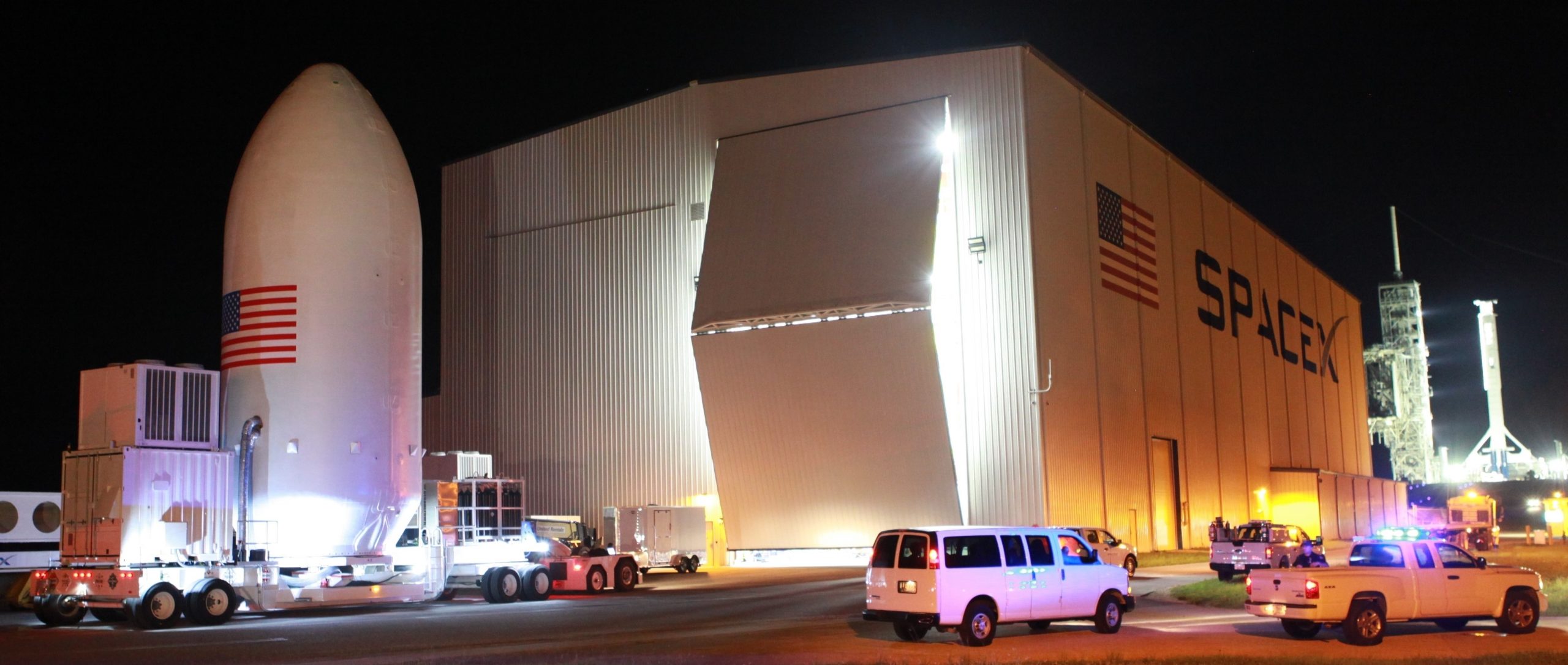
X-37B Mission-5 launched on 07SEP2017 from Cape Canaveral Air Force Station, Florida, on-board a Space X Falcon 9 booster (Air Force Awards Launch Services Contracts to SpaceX). Mission-6 will launch sometime in 2020.
Launch pod carrying X-37B is towed to the Space-X rocket, which can be seen waiting in the background, 05SEP2017. Photo via Boeing.
2017 official video explainer of the X-37B:
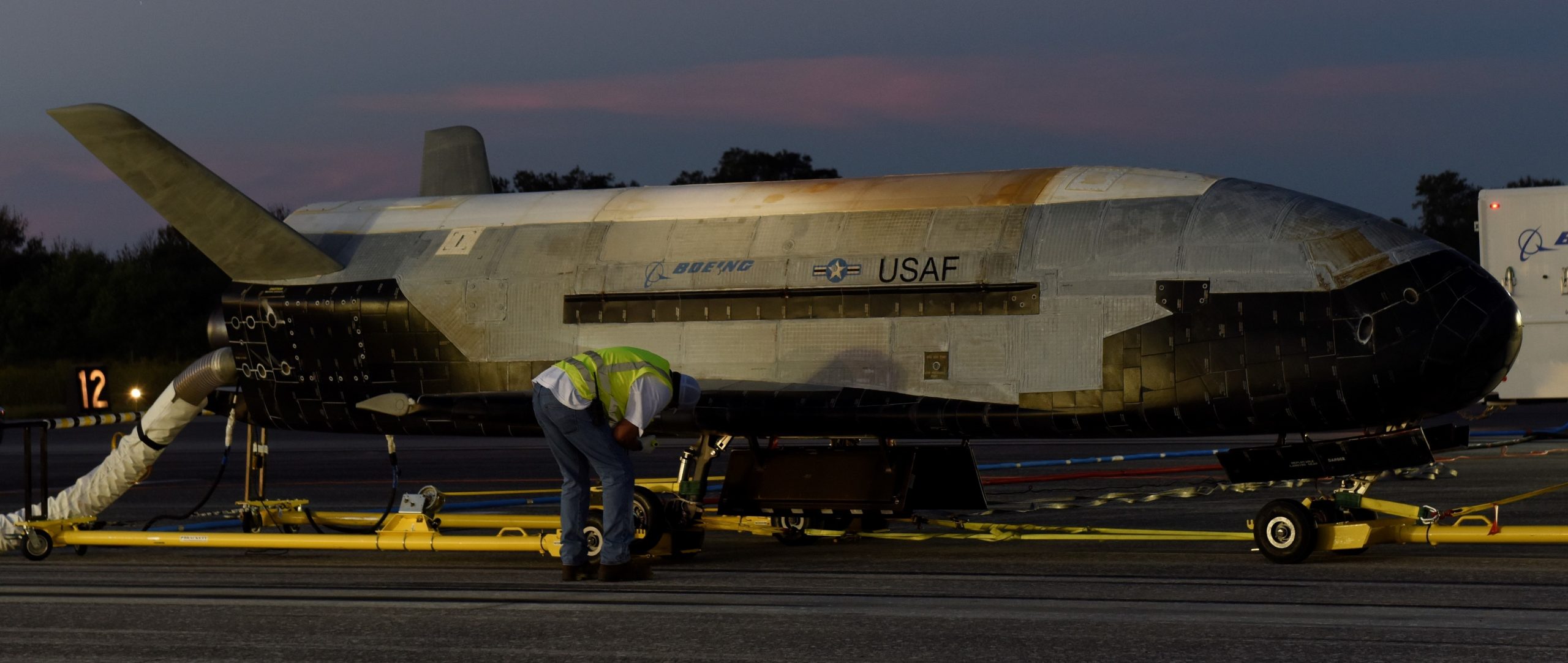
U.S. Air Force photo, 07MAY2017.
Video of X-37B Mission-4 landing, 07MAY2017, Kennedy Space Center. Watch as it roles past a Space Shuttle ‘gate guard’:
USAF photo, 07MAY2017.
What’s it like to have the X-37B fly over your head? Watch the video:
Before the use of a SpaceX rocket, the X-37B was launched by the old Atlas-5. Video, March 2015, Atlas-5 rocket launches AFSPC-5 satellite carrying X-37B from Cape Canaveral:
Video, 2012 Pentagon Report reveals unmanned space plane was taken over by DARPA from NASA:
The X-37B OTV being placed inside the launch capsule/pod, 31MAR2010. USAF photo.
27 October 2019 (03:03 UTC-07 Tango 06) 05 Aban 1398/27 Safar 1441/29 Jia-Xu 4717
In preparation for more flooding disasters, the Indiana National Guard expanded In-HART (Indiana Helicopter Aquatic Rescue Team) operations. In-HART is a joint operation that includes civilian rescue technicians and Indiana National Guard personnel.
On 24OCT2019, the South Bend Swift Water Rescue Team joined National Guard forces at the Muscatatuck Urban Training Center, as a way to increase the number of people trained for swift water rescues.
27 October 2019 (02:27 UTC-07 Tango 06) 05 Aban 1398/27 Safar 1441/29 Jia-Xu 4717
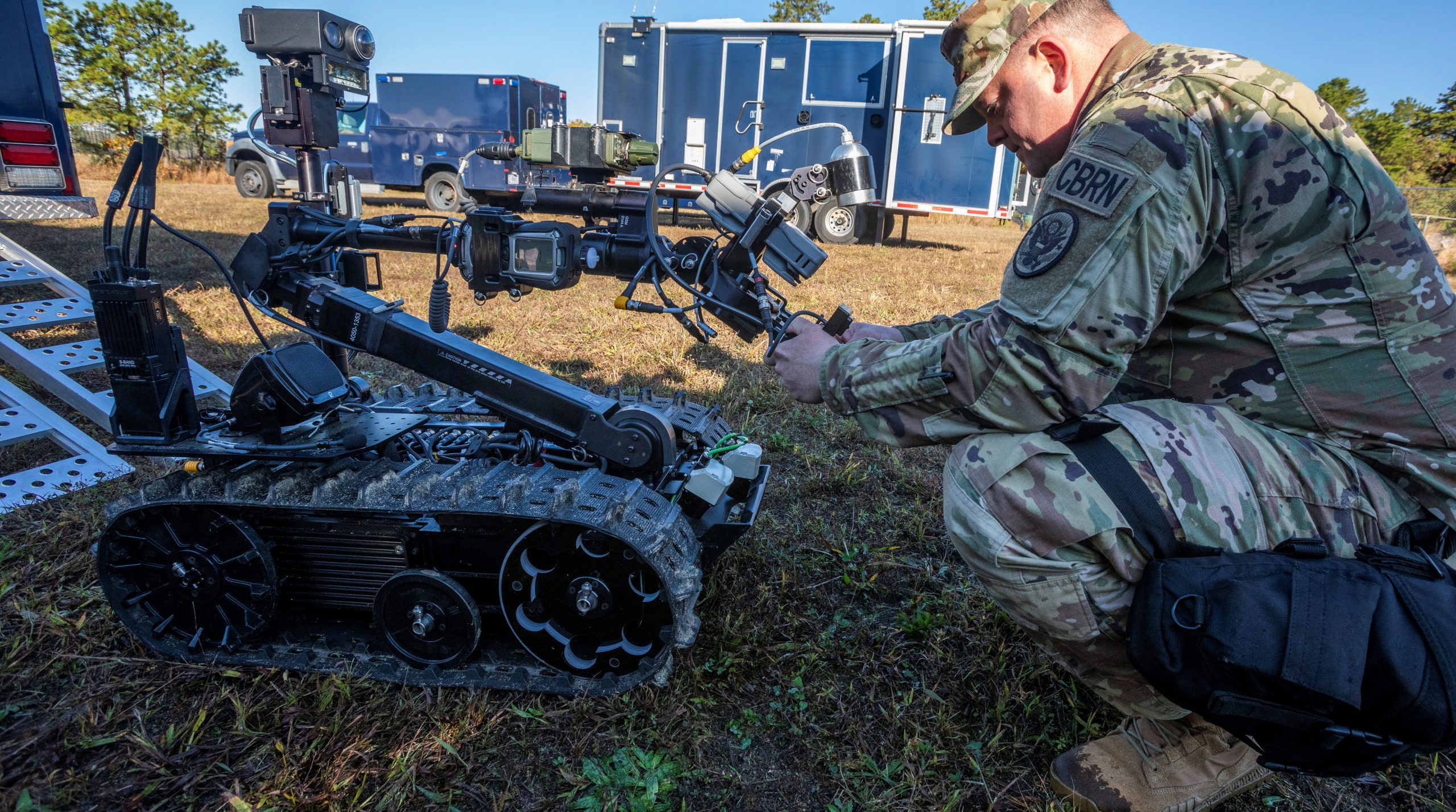
New Jersey National Guard photo by Mark C. Olsen.
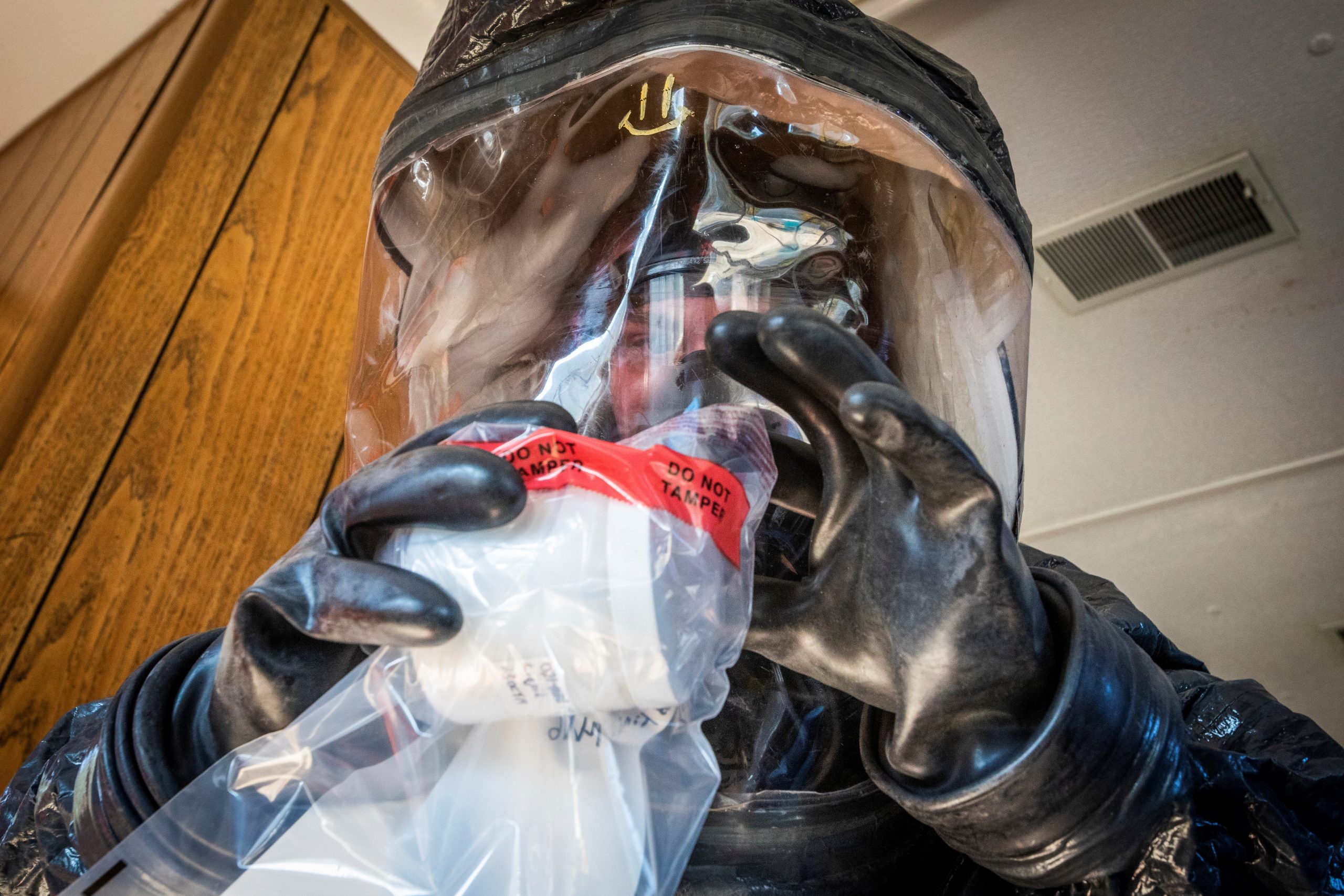
On 23OCT2019, the National Guard’s 21st Weapons of Mass Destruction-Civil Support Team (WMD-CST) Talon-4 robot was deployed in response to a potential WMD crime scene.
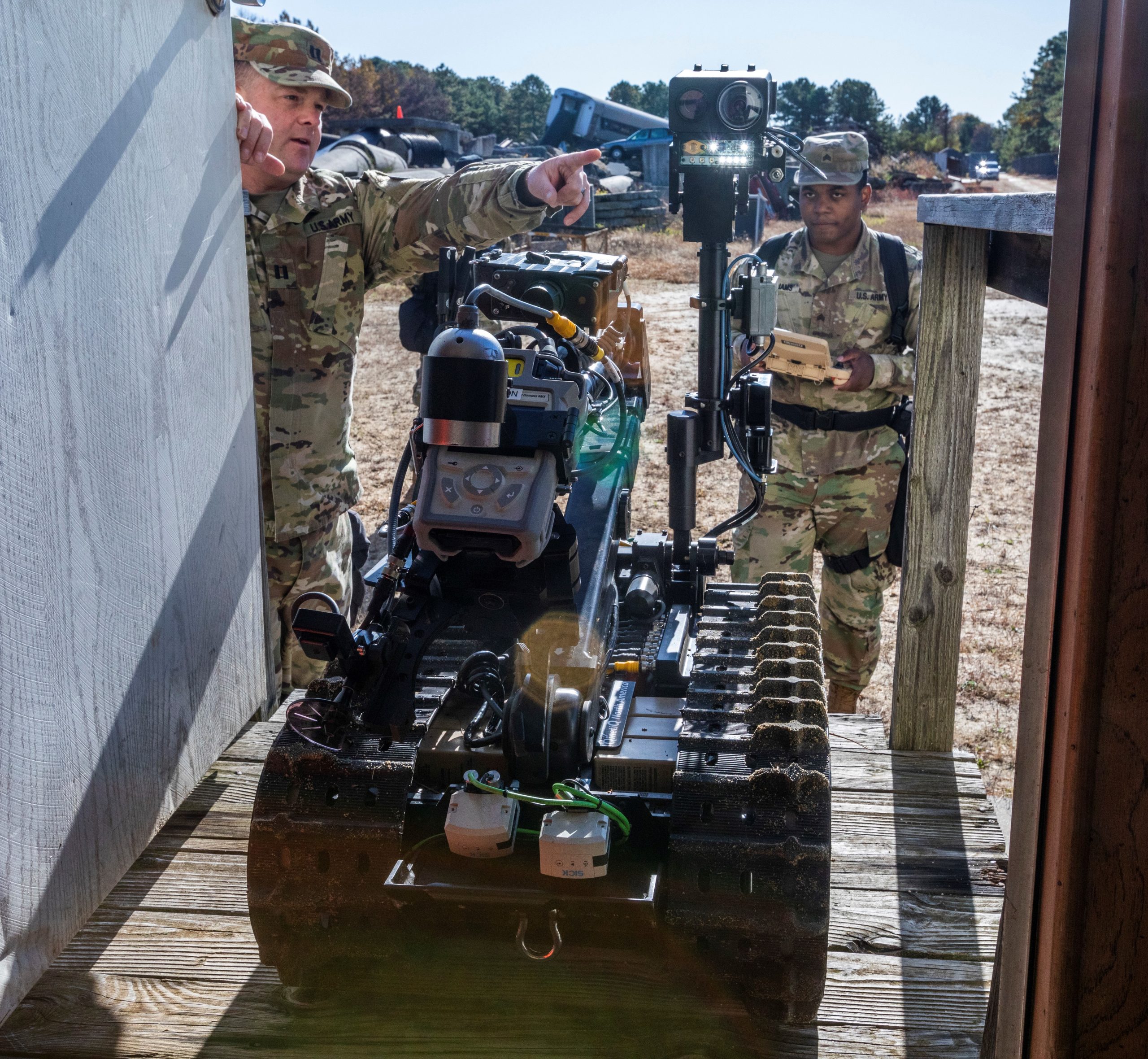
New Jersey National Guard photo by Mark C. Olsen.
Talon-4 was used to conduct an initial inspection of the scene, before humans went in.
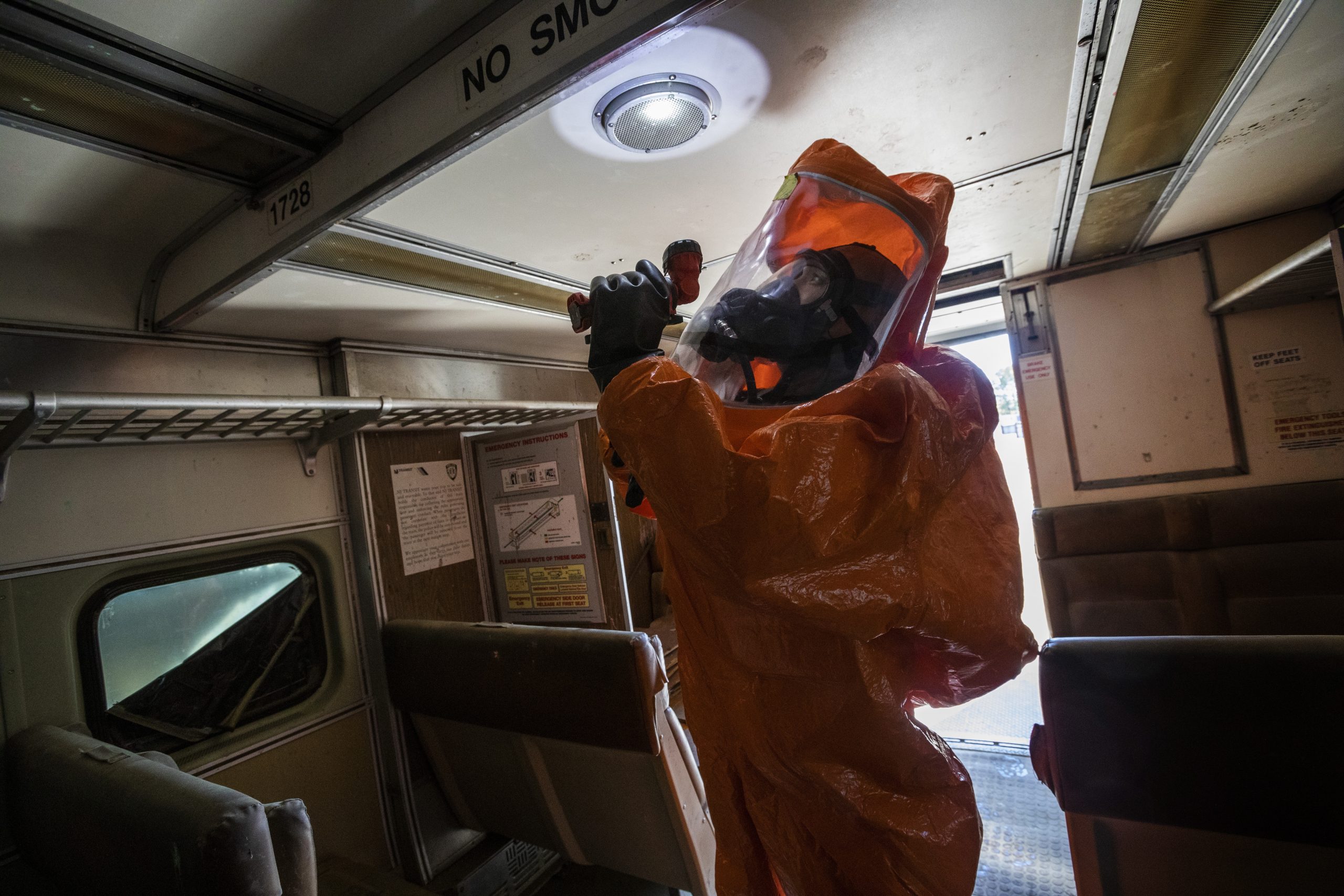
New Jersey National Guard photo by Mark C. Olsen.
The ‘crime scene’ was inside a New Jersey commuter train. National Guard personnel suited-up to inspect the scene for themselves.
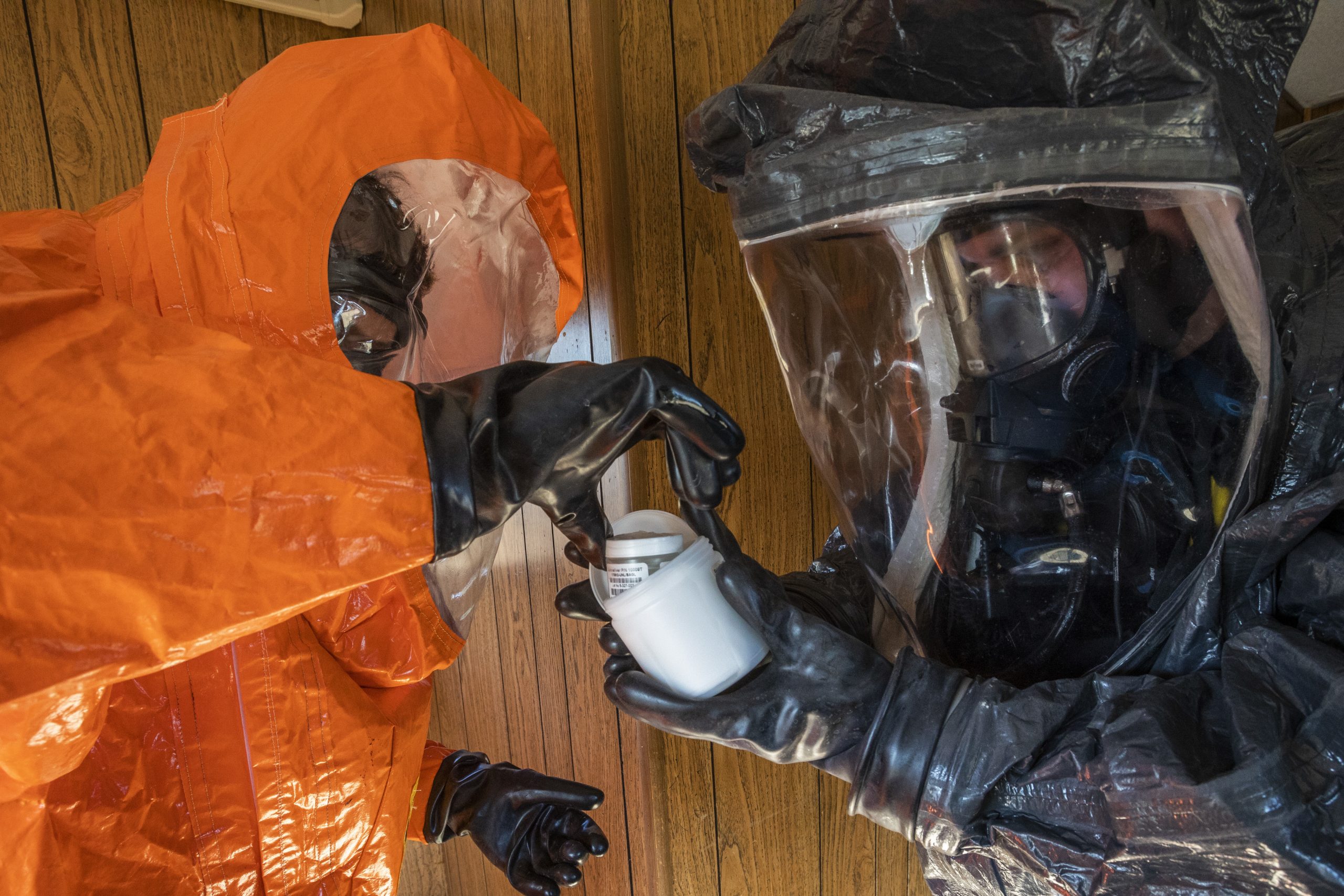
New Jersey National Guard photo by Mark C. Olsen.
Samples were taken and everything turned out okay.
New Jersey National Guard photo by Mark C. Olsen.
It was all part of training for New Jersey’s 21st WMD-CST, which supports silly-vilian (civilian) authorities in responding to man-made or natural disasters by identifying chemical, biological, radiological, and nuclear substances, assess the consequences, and advises on response measures.
Incomplete (tip-o-the iceberg) list of main-stream-news links about global immigrant/border operations affecting the United States taxpayers, September 2019.
The state militia publicly remembered the 103rd anniversary of its deployment to the Mexican border in September 1916, in response to Mexican rebel raids into the U.S.
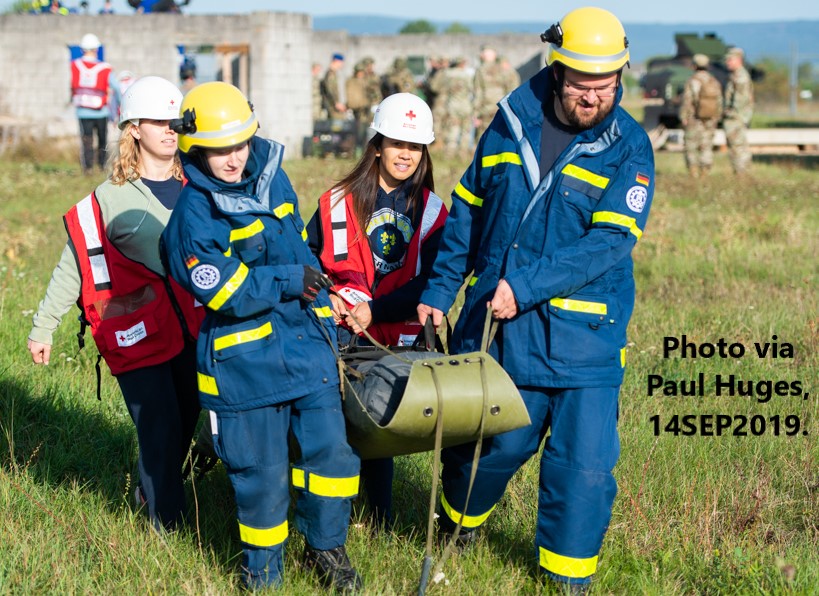
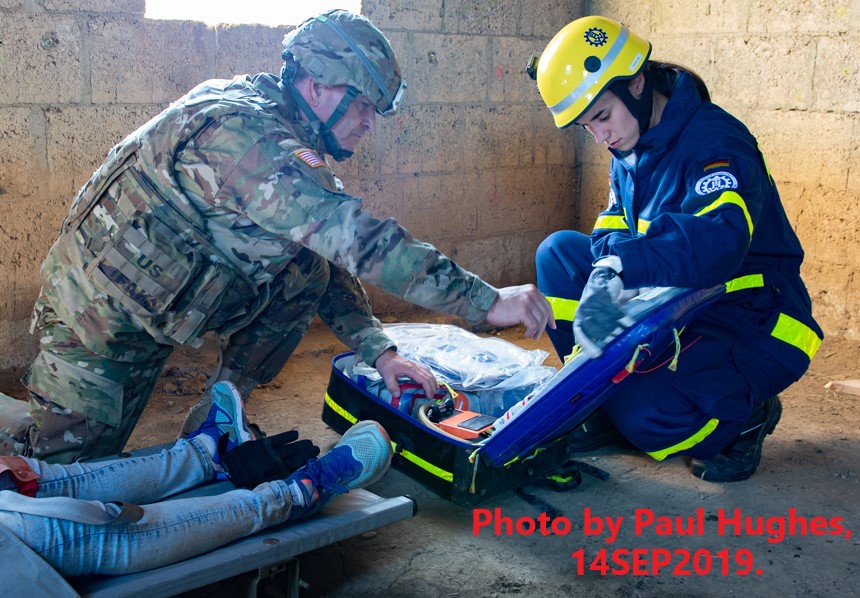
“The normal infrastructure was completely down and therefore our team came in to do our quick assessment. The Bundeswehr came out and they’re getting assessed on what they do on their medical side.”-Specialist Christopher Wise, U.S. Army Europe
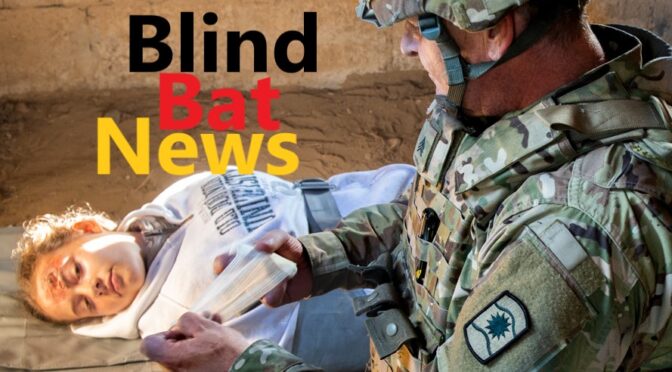
On 14SEP2019 Wackernheim, Germany, was rocked by a 6.2 earthquake. U.S. and German Soldiers rescued casualties from the debris, evacuated them to a medical treatment area and rendered first aid.
Just kidding! It was part of NATO war game Cobra Strike 19. Here’s the boring official video explainer:
Here’s a slightly better video explainer:
Earthquakes are rare in Germany, but every now and then they have a big one. Seismicity in Germany

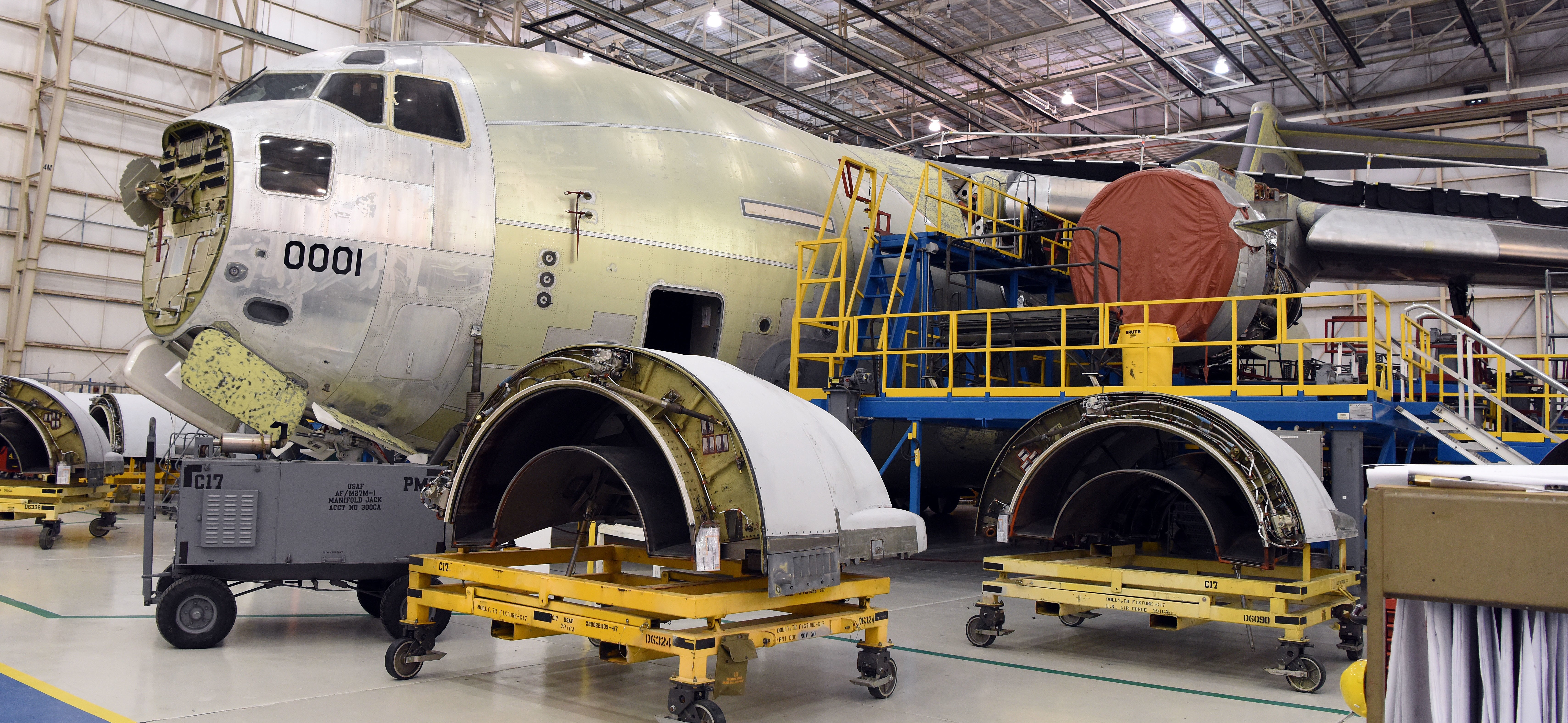 C-17 STRIPPED
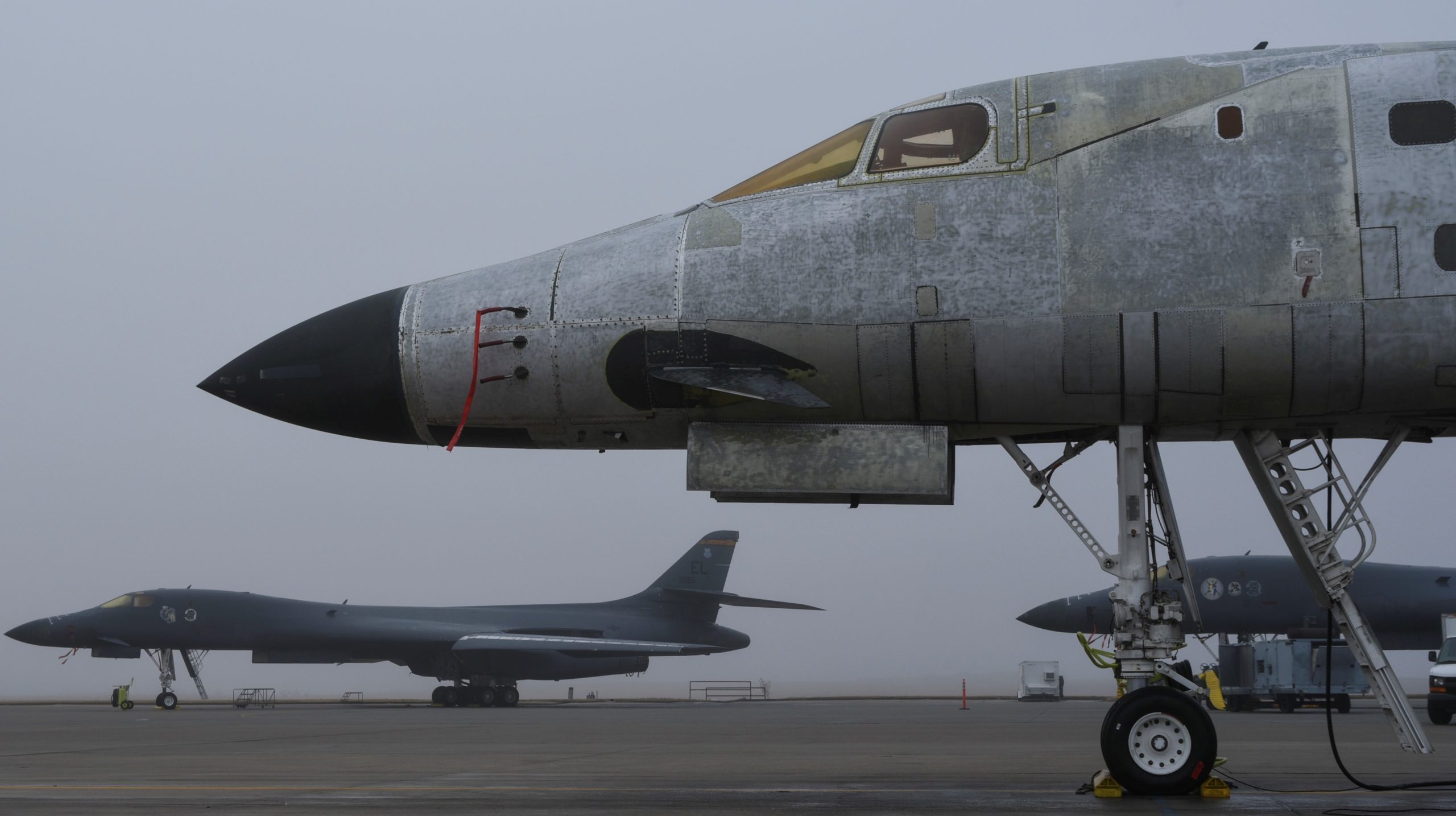
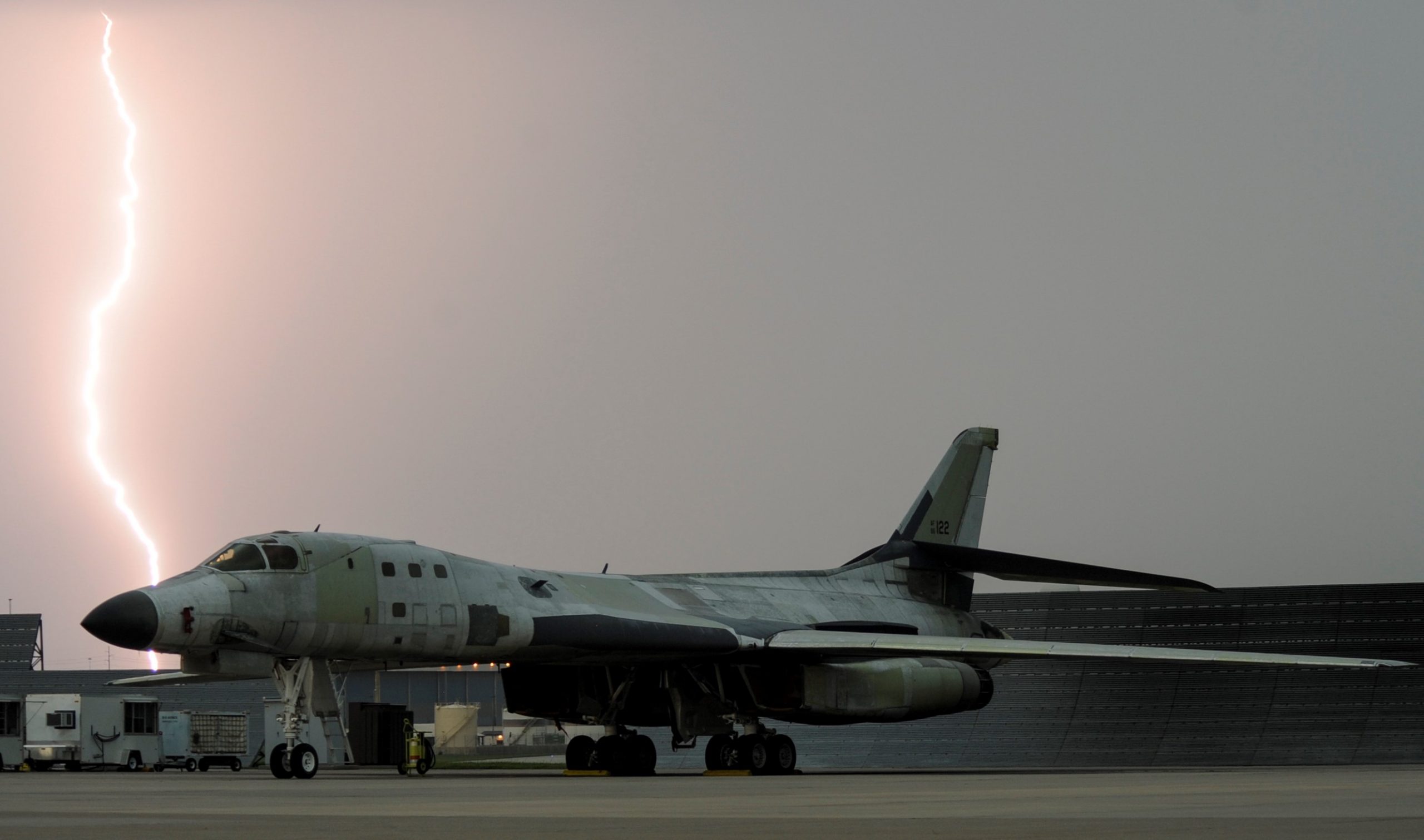
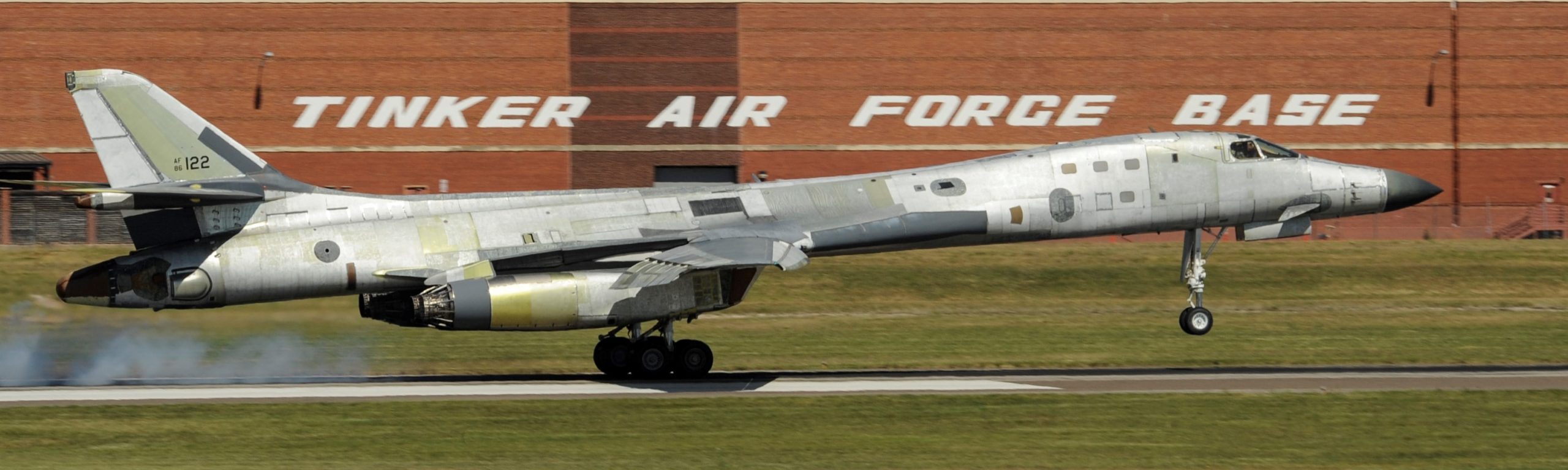
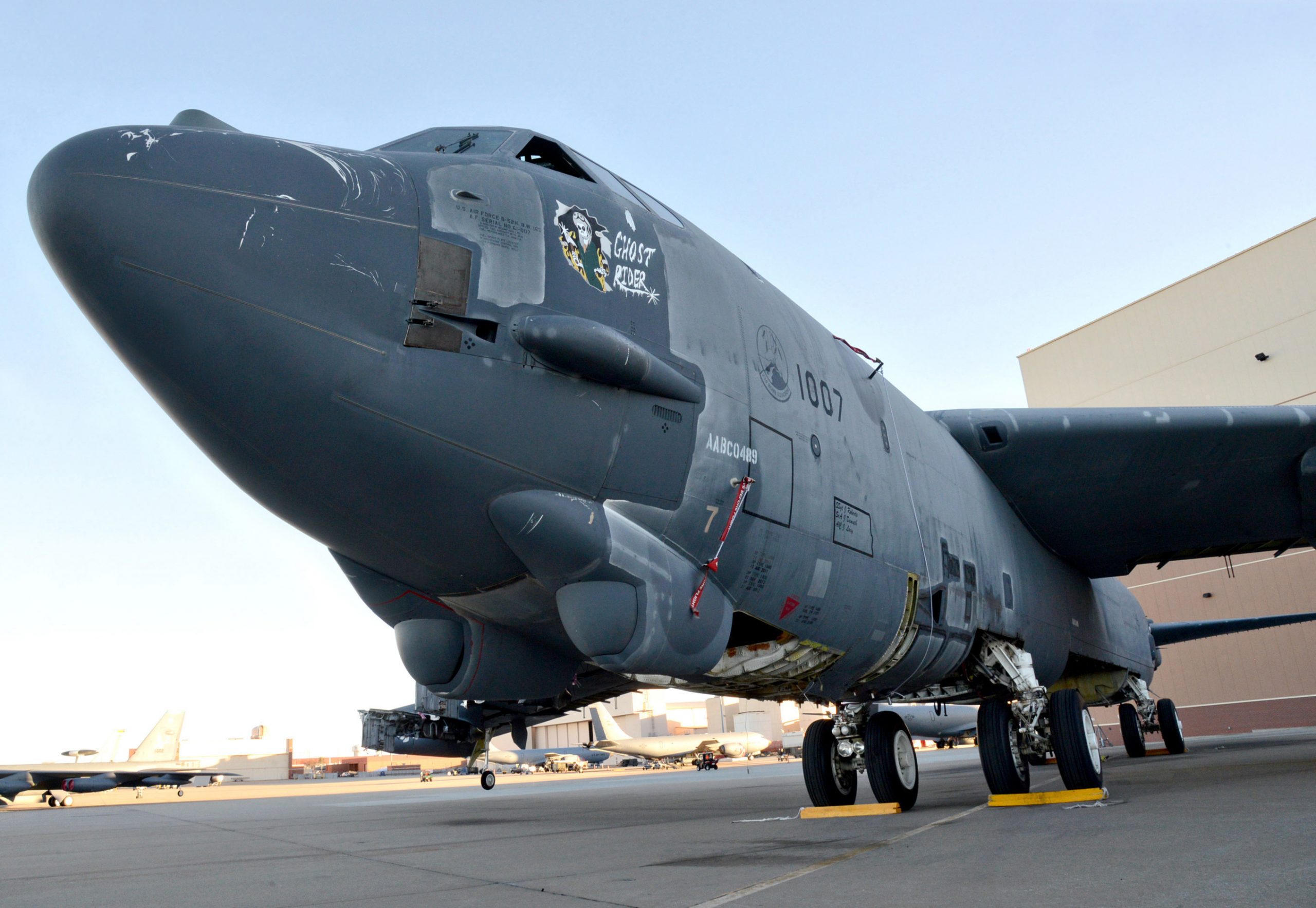
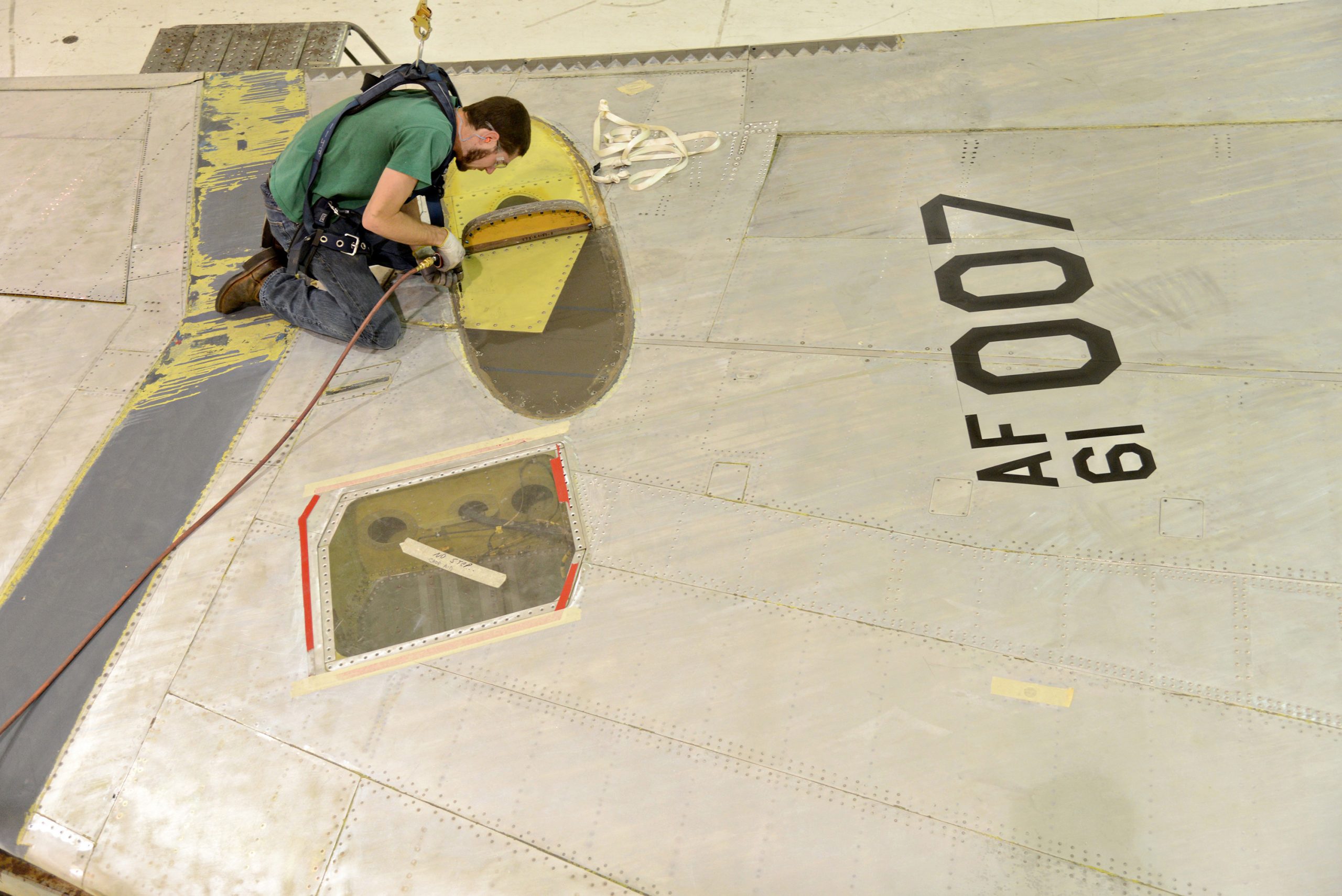
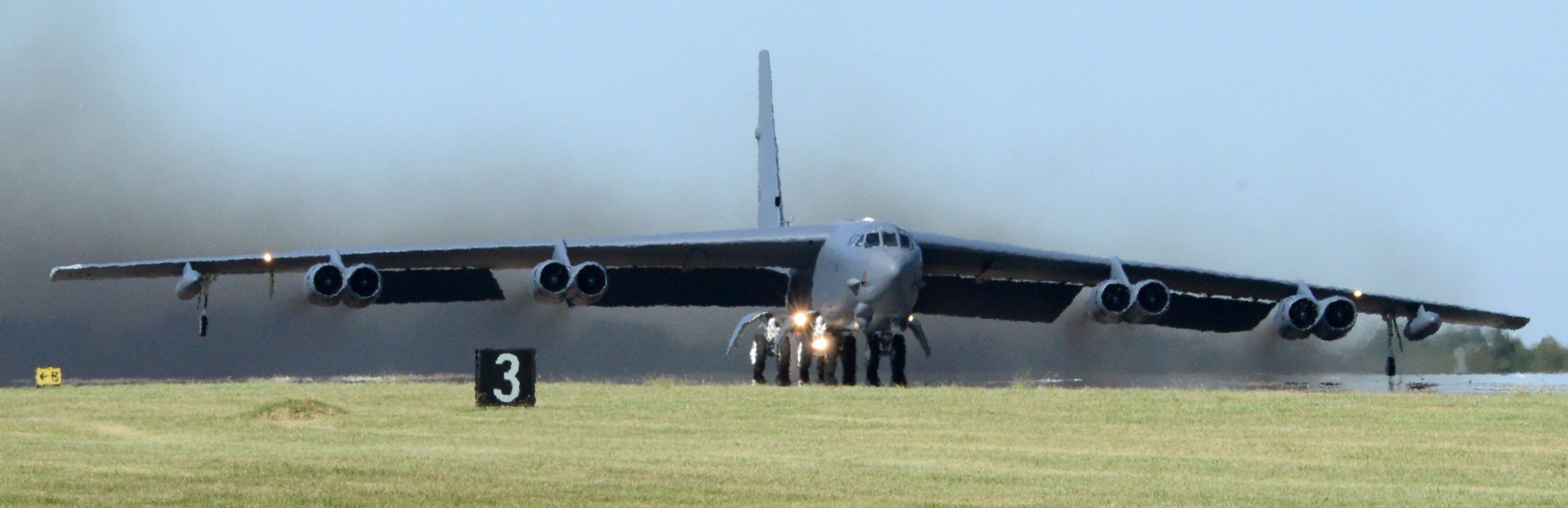
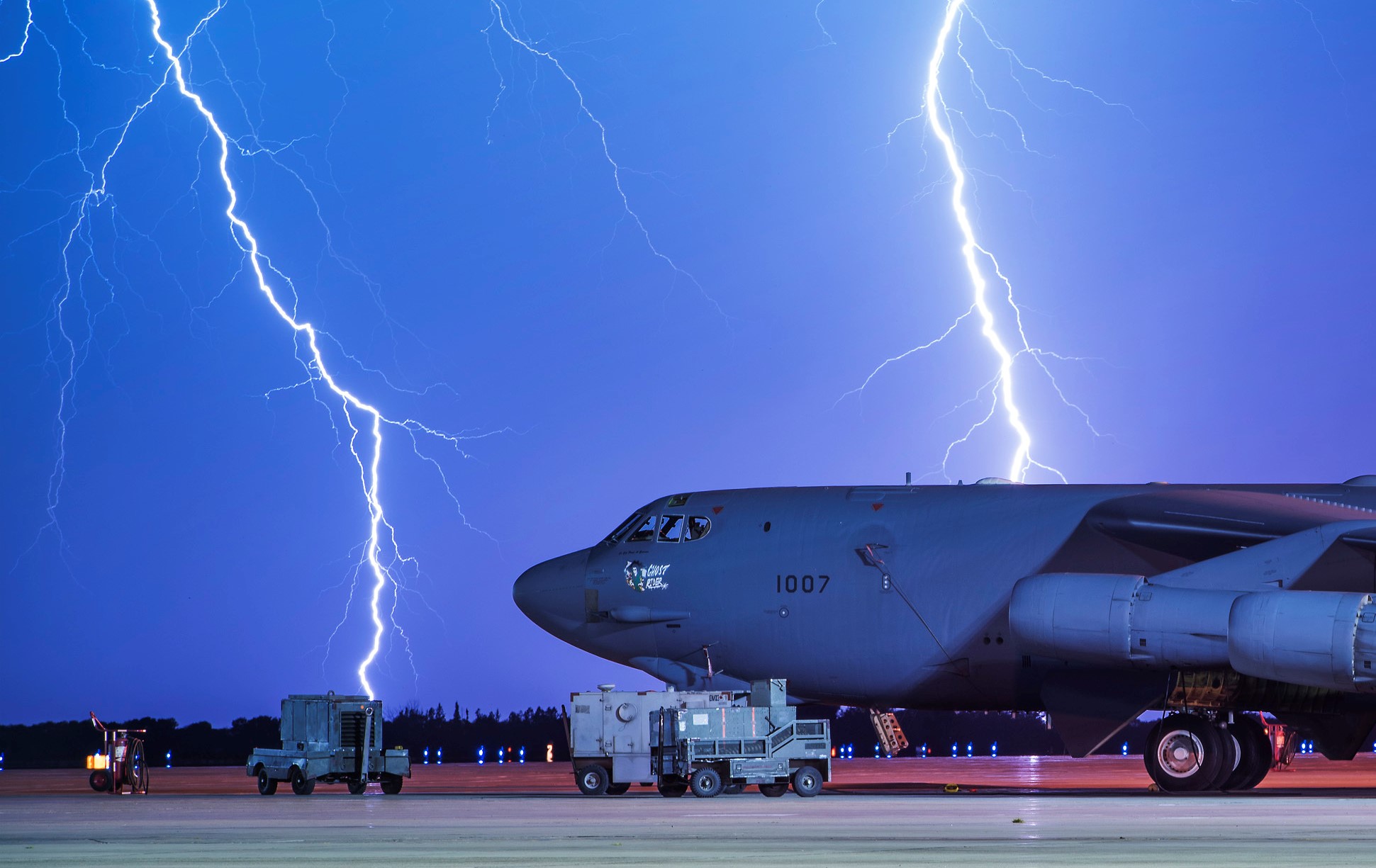
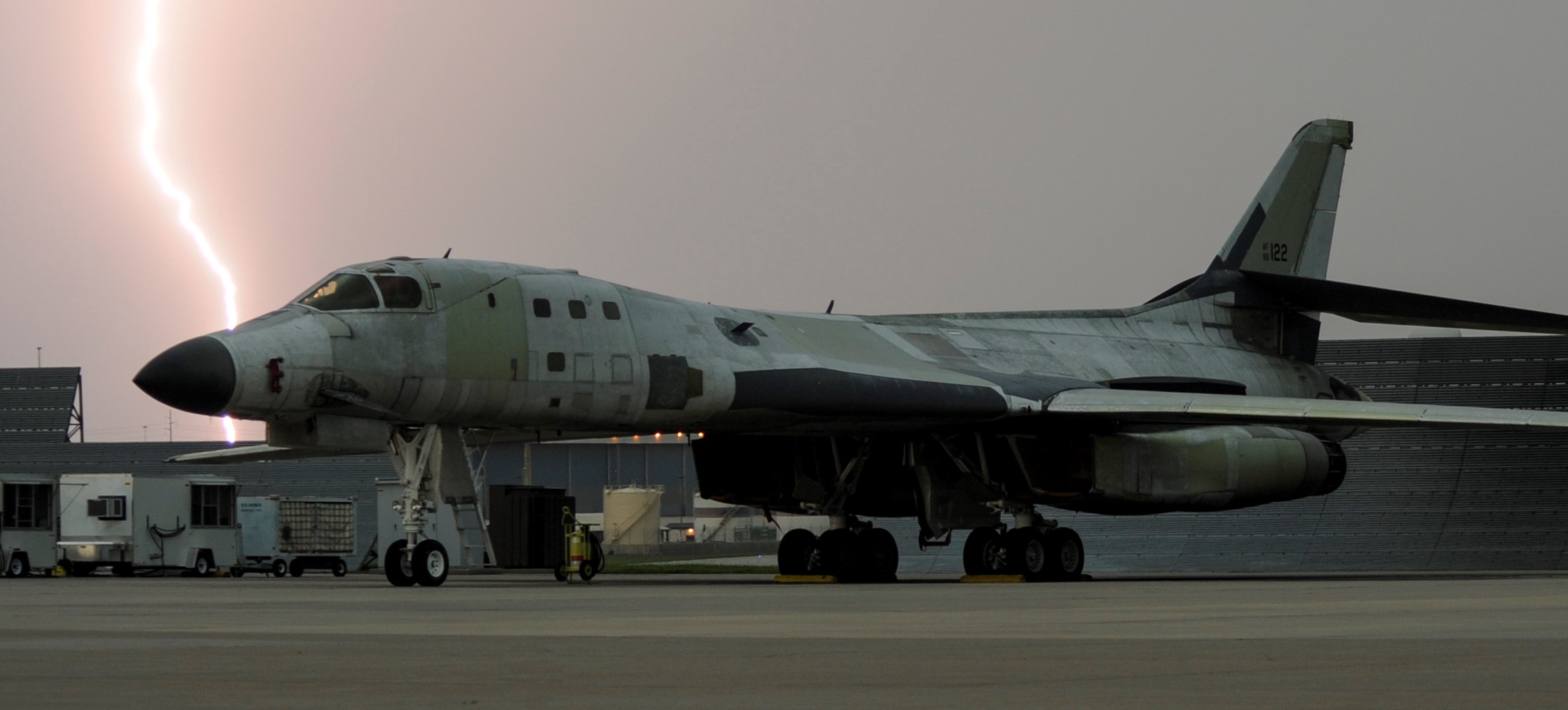 B-1B & B-52H
 All jacked-up!
 Thrust reverser doors waiting to be re-installed.

 Those turbines are hungry.
 New door hinges.

 New leading edge slat seals.
 Trailing edge panels.
 Prepping for new fuel tank seals.
 The two years long NASA-California methane mission resulted in the AVIRIS-NG ( Airborne Visible InfraRed Imaging Spectrometer-Next Generation) system, onboard the ER-2, discovering dozens of what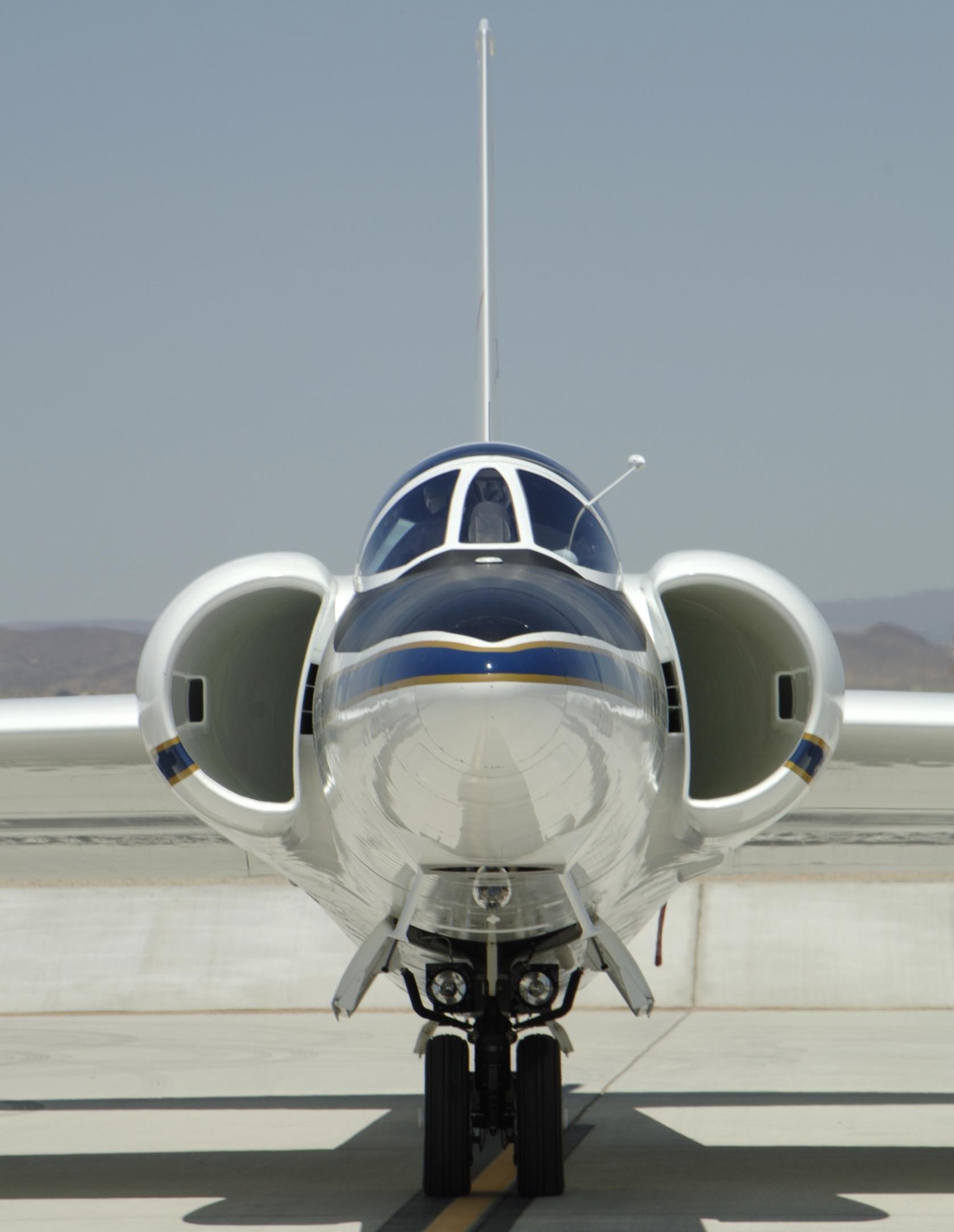


 Somewhere in the eastern Pacific, 11OCT2019, U.S. Coast Guard personnel pose on top of the drug smuggling submarine they captured. During an eight week period the Coast Guard captured 11 smugglers and an estimated U.S.$216-million worth of illegal drugs.
 U.S. Coast Guard captured 95 illegals being trafficked aboard a ship from Dominican Republic, 06OCT2019.



 The first wall panel goes up at the Yuma 5 Mile Project, 05SEP2019.
 CBP personnel ‘process’ survivors of Hurricane Dorian, evacuating from Bahamas, 07SEP2019.
 The state militia publicly remembered the 103rd anniversary of its deployment to the Mexican border in September 1916, in response to Mexican rebel raids into the U.S.